Tuesday, March 25, 2014
Yellow Birch
Food: Broken twigs of the Yellow birch (B. alleghaniensis) and Black or Sweet birch (B. Nigra) have a wintergreen fragrance. A sap can be collected and boiled down from Yellow birch. From Black birch harvest the twigs, red inner bark and larger roots. The inner bark can be boiled or ground into a flour. Twigs and inner bark can be steeped into a tea. Wintergreen flavor is stronger in Black birch.
Medicine: Chippewa made a medicine from Black and White birch (B. papyrifera) for stomach pain.
birch leaf Pictures, Images and Photos
Technology: New England tribes used the bark of White or Paper Birch for many purposes. Large bark sheets were stripped from the tree in late spring to use as house coverings or to build canoes. Smaller pieces of bark were cut into patterns and used to make dishes and utensils, including seamless maple sap collecting dishes and maple sugar storage containers (makaks). The bark was also cut and folded to make baskets, fans and even tinder to fish by torchlight from canoes. Folding and biting single thin layers of the paper produced dental pictographs, or birch bark transparencies, that could be used for beadwork designs and patterns for other decorations.
Note: Indian legend surround the distinctive markings of the birch tree. The bark of this tree was never taken without acknowledgement its importance to Native Americans and without offering and thanks to the spirits that provide it. Read the Ojibwe story of Winnebojo & the Birch Tree. For additional information browse NativeTech's Uses of Birchbark.
I have many Yellow Birch on my land, but there is one I call the Queen of my forest...She is big and beautiful and in early spring when she id=s shedding her bark she is something to see!

Monday, April 8, 2013
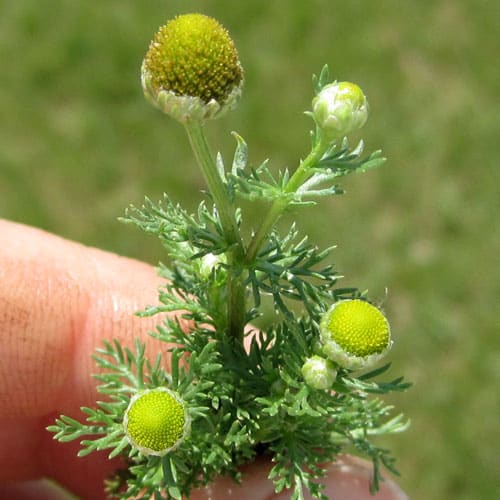
Pineapple Weed
Matricaria matricaioides
Identification: This plant is related to chamomile (M. chamomile). Pineapple weed is an annual, 10 - 40 cm tall with a non-rayed composite flower head. It does have a distinctive pineapple scent. Its leaves are pinnate.
Habitat & Distribution: Pineapple weed is found in almost all waste areas. It can be seen growing in cracks in the sidewalk in the centre of most towns and along many a backwoods dirt road.
Edible Parts: Pineapple weed may be eaten as a tasty snack item while hiking or added to a wild salad. It makes a calming tea when steeped in hot water. The crushed leaves, stems, and flowerheads may be applied to the skin as an insect repellent. A wash made of pineapple weed will remove greases from the hair and act as a general shampoo and natural hair tonic.
It can be used as a treatment for diarrhea, stomachaches, flatulence, as a mild relaxant, and for colds and menstrual problems. Externally it can be used for itching and sores.
Pineapple weed is an edible, medicinal plant that closely resembles wild chamomile. It’s prolific in the western U.S., (although I believe it can be found in the eastern U.S. as well). Wikipedia has a good article with some identifying characteristics and where to find it. If you keep your eyes peeled, you’ll start noticing the lacy foliage and little yellow flowers popping up in disturbed areas with poor soil. I live on a very hilly property, and anywhere that a bulldozer flattened out once upon a time now has pineapple weed growing all over it. I use this plant in place of chamomile for tea. It makes a soothing, mellow flavored tea that is wonderful with a little bit of honey. To use the herb fresh, snip off about a tablespoon of the yellow flowers and steep in hot water for a few minutes. To harvest and store for later use, gather it into bunches first thing in the morning and hang in a cool, dry place to dry. Snip off the buds and put them in a jar to preserve the flavor and aroma.
You can make tea with pineapple weed alone, but I like making mixtures with whatever I have lying around. A cup of this is especially good if you’re kind of feeling like crap…
Pineapple Weed Tea
makes: one 32 oz. french press (although you could easily change the amounts for whatever size press you have)
Ingredients:
1 tbs. dried pineapple weed – or- a few sprigs of fresh pineapple weed
5 fresh mint leaves
1 tbs. loose-leaf tea, such as Oolong
honey to taste
a few tablespoons of milk (optional, to taste)
(I’m wondering if I need to write directions out for this? I will anyway though…)
Heat a kettle of water to just shy of boiling.
Put pineapple weed, oolong tea, and mint leaves into a french press.
Pour hot water into press and let everything steep for 3-4 minutes. Press, and pour into cups. Stir in honey and milk to taste.
Remember….
When you’re foraging for plants, make sure they’re not from an area that’s been contaminated by pollutants such as run off from a road. Know your plants some look a likes will kill you.
Thursday, December 13, 2012
"How To Make A Poultice" (To Treat Many Skin Ailments!)
You can make a poultice to draw infection, treat boils and abcesses, relieve inflammation or a rash or simply draw the poison from a bee sting!
What is a poultice? A homemade poultice is made by mashing herbs, plant material or another substance with warm water or natural oils to make a paste. The paste can be applied directly to the skin and covered with a piece of clean cloth. If the herb used is potent such as onion, garlic, ginger, mustard, etc., you may want a layer of thin cloth between the skin and the herb. The cloth can then be covered with plastic wrap to hold in the moisture. The poultice can be changed every 3 to 4 hours or whenever it dries out.
A compress is used the same way but usually warm liquids are applied to the cloth instead of raw substances. Tinctures or herbal infusions are great for compresses.
The list of ingredients to use for a homemade poultice is endless!
Make a Poultice for Boils, Infections, Abcesses and Inflammation
The following poultice ingredients have properties to draw out infections reduce inflammation. These poultices can even be used to treat chest congestion, hemorrhoids and earaches. Don't forget that you can use poultices or compresses on your pets and livestock also!
Onion Poultice- mash raw onion and mix with warm water or organic plant oils. You may want a thin layer of cloth between your skin and the onion.
Watch a video on how to make an onion poultice here. (More instructional videos can be seen at the bottom of this page)
Potato Poultice- Grate a raw potato and make your paste! A potato poultice is good for inflammation and eye troubles such as conjunctivitis.
Mustard Poultice - Mash some mustard seeds, mix with natural oil or water and apply. Use thin cloth between paste and skin. A homemade mustard poultice is very powerful and can burn your skin if applied directly.
Plantain Poultice- Plantain is a commom weed that has great drawing power. Mash the fresh weed for the paste or use a tincture as a compress. See the Insect Bite Remedy Page for more information on plantain.
Activated Charcoal - Super absorbing properties!
Comfrey Poultice - Comfrey roots and leaves have great healing properties especially where bones and ligaments are involved! Make a poultice out of comfrey for any aches or pains.
Tumeric Poultice- Organic Tumeric makes a great drawing poultice for boils and infections. For even better results take up to one teaspoon tumeric in a cup of warm milk along with using the external tumeric poultice. (Tumeric is also known as turmeric or curcuma.)
Cayenne Pepper makes a great compress for arthritis and many other aches and pains.
Bread and Milk poultice - These work very well for infections and boils. Simply heat milk and add a bit of bread, wrap in gauze or cheese cloth and place on cut or wound. Use as hot as you can stand it. Repeat a few times a day as long as necessary. It works pretty fast and often much better than over the counter products.
Lemon Balm Poultice - Lemon balm leaves make a poultice for small wounds, cold sores and insect bites.
Mountain Rose Herbs. A herbs, health and harmony c
MAKE A COMFREY POULTICE FOR SPRAINS AND BRUISES
1. Snip or crush a small handful of comfrey leaves into a dish.
2. Pour enough boiling water on the leaves to cover them.
3. Mash into a pulp with a spoon. A pestle and mortar works great for this!
4. Let cool a little then spread the pulp directly on the affected area. Cover with gauze and bandage to hold in the poultice in place. Leave on for several hours.
MAKE A SLIPPERY ELM AND THYME POULTICE FOR BOILS
Slippery elm has great healing properties and thyme is a great antiseptic. Try a plantain poultice for boils also.
1. Mash thyme leaves and cover with boiling water (same as comfrey poultice).
2. Pour off excess water and mix in 2 tablespoons of slippery elm powder.
3. Apply directly to the boil or enclose the pulp in gauze. Leave in place for several hours.


Saturday, September 22, 2012
 Happy Autumn and Autumn Equinox!
The equinox is a special time when the day and night are of equal lengths.
Traditionally, the Autumn Equinox is a time to give thanks for the harvest, and honor bounty and the gifts of the Mother Earth. It
is also a time to reflect on your journey, enjoy the fruits of your personal harvests and contemplate the path in front of you.
Balance is the keyword for equinox time. It is a time to look inside, seek balance and embrace both the dark and light sides of yourself. As the night continuing to grow longer and the earth energy moving into stillness and darkness of winter, we need to align our energy to the earth dormant cycle and the stillness within.
Happy Autumn! Let us celebrate this seasonal shift and enjoy golden days as the autumn leaves begin to turn color.
Happy Autumn and Autumn Equinox!
The equinox is a special time when the day and night are of equal lengths.
Traditionally, the Autumn Equinox is a time to give thanks for the harvest, and honor bounty and the gifts of the Mother Earth. It
is also a time to reflect on your journey, enjoy the fruits of your personal harvests and contemplate the path in front of you.
Balance is the keyword for equinox time. It is a time to look inside, seek balance and embrace both the dark and light sides of yourself. As the night continuing to grow longer and the earth energy moving into stillness and darkness of winter, we need to align our energy to the earth dormant cycle and the stillness within.
Happy Autumn! Let us celebrate this seasonal shift and enjoy golden days as the autumn leaves begin to turn color.
Friday, June 8, 2012
Wild Edible Plants
Benefits, Hazards, and Major Groups
 We are surrounded by wild edible plants everyday. In trying to learn about them, you might quickly feel overwhelmed by the staggering amount of information available. Here are some important consideration for getting started:
- Identifying Plants
- Benefits
- Hazards
- Major Groupings
Identifying Plants
It is vital that you can identify the wild edible plants that you intend to utilize. Some edible plants have deadly poisonous look-alikes. Good field guides are invaluable. The best guides clearly explain identification, collection, and preparation techniques. We highly recommend the following guides:
- Identifying and Harvesting Wild Edible and Medicinal Plants by Steve Brill
- Discovering Wild Plants by Janice Schofield
Benefits
Wild edible plants are very beneficial for you and your family for many reasons. First of all, there are wild edibles growing near you no matter what part of the world you live in. Chances are good, you can find a large number of species where you live and some of them are likely to be plentiful.
Secondly, many wild plants are highly nutritious and can be even more nutritious than many store bought fruits and vegetables. For instance, dandelion which you might think of as little more than a garden-variety weed is actually an incredibly nutritious wild edible plant. In a single hundred gram amount of cooked dandelion greens, there is 11,000 mg of Potassium, 18 mg of vitamin C and 42 mg of calcium.
You might consider eating the dandelions in your yard, rather than removing or poisoning them. Though if you are going to consume wild edible plants, make sure you also consider the hazards.
Hazards
There are some dangers in collecting and eating wild edibles. To begin with, think about the location you are gathering and consider the following:
- Is the area sprayed with pesticides or herbicides?
- Is the area close to a busy road or other source of pollution?
- Does your target species have any poisonous look-alikes?
Also consider that wild edible plants are often more nutritionally concentrated than store bought foods - you may not need to eat as much quantity as you would of foods from home. It is also wise to start off eating very small quantities of wild edible plants, especially those you have not tried before, in case of potential allergic reactions. Test them before you collect or eat large quantities.
Also, the hazard many people forget to consider, and it is one of the most important, is the hazard you pose to the plants themselves!
Please practice wise and sustainable harvesting techniques. Consider the needs of the plants and the other animals that might feed on them.
If the plant you are harvesting is rare, is the only one of its kind on the location you are harvesting or especially if it is endangered, leave it alone!
Look for places where the species you are interested in gathering is plentiful. Also look for plants that have abundant fruit, nuts or berries. This will make your job of gathering less work and also, if you are considerate, it will leave less of an impact on the land. A good guidelines is to collect one third of the plant material, leaving two thirds for plant regeneration and wildlife.
Major Groupings of Wild Edible Plants
There are so many different kinds of plants out there in the world. It can really help to initially lump them into more manageable groups. Here are some of the major groups of wild edibles, organized by plant families:
The Lily Family (Liliaceae): This includes species such as:
- Wild onions
- Wild garlic
- Wild leeks
- Camas
- Glacier lilies
The Purslane Family (Portulacaceae): This includes:
- Miner’s Lettuce
- Spring Beauty
The Rose Family (Rosaceae): This includes edible plants such as:
- Blackberry
- Raspberry
- Salmonberry
- Thimbleberry
- Wild roses
- Hawthorn
- Serviceberry
- Choke-cherry
- Wild strawberry
- Silverweed
The Heath Family (Ericaceae): This includes species such as:
- Cranberry
- Blueberry
- Huckleberry
The Mustard Family (Brassicaceae): This includes plants such as:
- Pennycress
- Shepard’s purse
- Watercress
The Mint Family (Lamiaceae): This includes wild edibles such as:
- Wild mint
- Self-heal
The Sunflower Family (Asteraceae): This includes species such as:
- Dandelion
- Wild sunflower
- Salsify
- Chicory
- Pineapple weed
- Oxeye daisy
- Common burdock
- Thistle species
The Nettle Family (Urticaceae): This includes:
- Stinging nettle
The Cattail Family (Typhaceae): This includes:
- Narrow-leaf and broad-leaved cattail
The Beech Family (Fagaceae): This includes:
- Oaks
- Chestnuts
- Beeches
The Pine Family (Pinaceae): This includes trees such as:
- Pine
- Hemlock
- Douglas-fir
- Spruce
With proper identification and careful consideration of safety & potential hazards, edible wild plants can become an exciting and healthful part of your diet. Happy foraging!
We are surrounded by wild edible plants everyday. In trying to learn about them, you might quickly feel overwhelmed by the staggering amount of information available. Here are some important consideration for getting started:
- Identifying Plants
- Benefits
- Hazards
- Major Groupings
Identifying Plants
It is vital that you can identify the wild edible plants that you intend to utilize. Some edible plants have deadly poisonous look-alikes. Good field guides are invaluable. The best guides clearly explain identification, collection, and preparation techniques. We highly recommend the following guides:
- Identifying and Harvesting Wild Edible and Medicinal Plants by Steve Brill
- Discovering Wild Plants by Janice Schofield
Benefits
Wild edible plants are very beneficial for you and your family for many reasons. First of all, there are wild edibles growing near you no matter what part of the world you live in. Chances are good, you can find a large number of species where you live and some of them are likely to be plentiful.
Secondly, many wild plants are highly nutritious and can be even more nutritious than many store bought fruits and vegetables. For instance, dandelion which you might think of as little more than a garden-variety weed is actually an incredibly nutritious wild edible plant. In a single hundred gram amount of cooked dandelion greens, there is 11,000 mg of Potassium, 18 mg of vitamin C and 42 mg of calcium.
You might consider eating the dandelions in your yard, rather than removing or poisoning them. Though if you are going to consume wild edible plants, make sure you also consider the hazards.
Hazards
There are some dangers in collecting and eating wild edibles. To begin with, think about the location you are gathering and consider the following:
- Is the area sprayed with pesticides or herbicides?
- Is the area close to a busy road or other source of pollution?
- Does your target species have any poisonous look-alikes?
Also consider that wild edible plants are often more nutritionally concentrated than store bought foods - you may not need to eat as much quantity as you would of foods from home. It is also wise to start off eating very small quantities of wild edible plants, especially those you have not tried before, in case of potential allergic reactions. Test them before you collect or eat large quantities.
Also, the hazard many people forget to consider, and it is one of the most important, is the hazard you pose to the plants themselves!
Please practice wise and sustainable harvesting techniques. Consider the needs of the plants and the other animals that might feed on them.
If the plant you are harvesting is rare, is the only one of its kind on the location you are harvesting or especially if it is endangered, leave it alone!
Look for places where the species you are interested in gathering is plentiful. Also look for plants that have abundant fruit, nuts or berries. This will make your job of gathering less work and also, if you are considerate, it will leave less of an impact on the land. A good guidelines is to collect one third of the plant material, leaving two thirds for plant regeneration and wildlife.
Major Groupings of Wild Edible Plants
There are so many different kinds of plants out there in the world. It can really help to initially lump them into more manageable groups. Here are some of the major groups of wild edibles, organized by plant families:
The Lily Family (Liliaceae): This includes species such as:
- Wild onions
- Wild garlic
- Wild leeks
- Camas
- Glacier lilies
The Purslane Family (Portulacaceae): This includes:
- Miner’s Lettuce
- Spring Beauty
The Rose Family (Rosaceae): This includes edible plants such as:
- Blackberry
- Raspberry
- Salmonberry
- Thimbleberry
- Wild roses
- Hawthorn
- Serviceberry
- Choke-cherry
- Wild strawberry
- Silverweed
The Heath Family (Ericaceae): This includes species such as:
- Cranberry
- Blueberry
- Huckleberry
The Mustard Family (Brassicaceae): This includes plants such as:
- Pennycress
- Shepard’s purse
- Watercress
The Mint Family (Lamiaceae): This includes wild edibles such as:
- Wild mint
- Self-heal
The Sunflower Family (Asteraceae): This includes species such as:
- Dandelion
- Wild sunflower
- Salsify
- Chicory
- Pineapple weed
- Oxeye daisy
- Common burdock
- Thistle species
The Nettle Family (Urticaceae): This includes:
- Stinging nettle
The Cattail Family (Typhaceae): This includes:
- Narrow-leaf and broad-leaved cattail
The Beech Family (Fagaceae): This includes:
- Oaks
- Chestnuts
- Beeches
The Pine Family (Pinaceae): This includes trees such as:
- Pine
- Hemlock
- Douglas-fir
- Spruce
With proper identification and careful consideration of safety & potential hazards, edible wild plants can become an exciting and healthful part of your diet. Happy foraging!
 We are surrounded by wild edible plants everyday. In trying to learn about them, you might quickly feel overwhelmed by the staggering amount of information available. Here are some important consideration for getting started:
- Identifying Plants
- Benefits
- Hazards
- Major Groupings
Identifying Plants
It is vital that you can identify the wild edible plants that you intend to utilize. Some edible plants have deadly poisonous look-alikes. Good field guides are invaluable. The best guides clearly explain identification, collection, and preparation techniques. We highly recommend the following guides:
- Identifying and Harvesting Wild Edible and Medicinal Plants by Steve Brill
- Discovering Wild Plants by Janice Schofield
Benefits
Wild edible plants are very beneficial for you and your family for many reasons. First of all, there are wild edibles growing near you no matter what part of the world you live in. Chances are good, you can find a large number of species where you live and some of them are likely to be plentiful.
Secondly, many wild plants are highly nutritious and can be even more nutritious than many store bought fruits and vegetables. For instance, dandelion which you might think of as little more than a garden-variety weed is actually an incredibly nutritious wild edible plant. In a single hundred gram amount of cooked dandelion greens, there is 11,000 mg of Potassium, 18 mg of vitamin C and 42 mg of calcium.
You might consider eating the dandelions in your yard, rather than removing or poisoning them. Though if you are going to consume wild edible plants, make sure you also consider the hazards.
Hazards
There are some dangers in collecting and eating wild edibles. To begin with, think about the location you are gathering and consider the following:
- Is the area sprayed with pesticides or herbicides?
- Is the area close to a busy road or other source of pollution?
- Does your target species have any poisonous look-alikes?
Also consider that wild edible plants are often more nutritionally concentrated than store bought foods - you may not need to eat as much quantity as you would of foods from home. It is also wise to start off eating very small quantities of wild edible plants, especially those you have not tried before, in case of potential allergic reactions. Test them before you collect or eat large quantities.
Also, the hazard many people forget to consider, and it is one of the most important, is the hazard you pose to the plants themselves!
Please practice wise and sustainable harvesting techniques. Consider the needs of the plants and the other animals that might feed on them.
If the plant you are harvesting is rare, is the only one of its kind on the location you are harvesting or especially if it is endangered, leave it alone!
Look for places where the species you are interested in gathering is plentiful. Also look for plants that have abundant fruit, nuts or berries. This will make your job of gathering less work and also, if you are considerate, it will leave less of an impact on the land. A good guidelines is to collect one third of the plant material, leaving two thirds for plant regeneration and wildlife.
Major Groupings of Wild Edible Plants
There are so many different kinds of plants out there in the world. It can really help to initially lump them into more manageable groups. Here are some of the major groups of wild edibles, organized by plant families:
The Lily Family (Liliaceae): This includes species such as:
- Wild onions
- Wild garlic
- Wild leeks
- Camas
- Glacier lilies
The Purslane Family (Portulacaceae): This includes:
- Miner’s Lettuce
- Spring Beauty
The Rose Family (Rosaceae): This includes edible plants such as:
- Blackberry
- Raspberry
- Salmonberry
- Thimbleberry
- Wild roses
- Hawthorn
- Serviceberry
- Choke-cherry
- Wild strawberry
- Silverweed
The Heath Family (Ericaceae): This includes species such as:
- Cranberry
- Blueberry
- Huckleberry
The Mustard Family (Brassicaceae): This includes plants such as:
- Pennycress
- Shepard’s purse
- Watercress
The Mint Family (Lamiaceae): This includes wild edibles such as:
- Wild mint
- Self-heal
The Sunflower Family (Asteraceae): This includes species such as:
- Dandelion
- Wild sunflower
- Salsify
- Chicory
- Pineapple weed
- Oxeye daisy
- Common burdock
- Thistle species
The Nettle Family (Urticaceae): This includes:
- Stinging nettle
The Cattail Family (Typhaceae): This includes:
- Narrow-leaf and broad-leaved cattail
The Beech Family (Fagaceae): This includes:
- Oaks
- Chestnuts
- Beeches
The Pine Family (Pinaceae): This includes trees such as:
- Pine
- Hemlock
- Douglas-fir
- Spruce
With proper identification and careful consideration of safety & potential hazards, edible wild plants can become an exciting and healthful part of your diet. Happy foraging!
We are surrounded by wild edible plants everyday. In trying to learn about them, you might quickly feel overwhelmed by the staggering amount of information available. Here are some important consideration for getting started:
- Identifying Plants
- Benefits
- Hazards
- Major Groupings
Identifying Plants
It is vital that you can identify the wild edible plants that you intend to utilize. Some edible plants have deadly poisonous look-alikes. Good field guides are invaluable. The best guides clearly explain identification, collection, and preparation techniques. We highly recommend the following guides:
- Identifying and Harvesting Wild Edible and Medicinal Plants by Steve Brill
- Discovering Wild Plants by Janice Schofield
Benefits
Wild edible plants are very beneficial for you and your family for many reasons. First of all, there are wild edibles growing near you no matter what part of the world you live in. Chances are good, you can find a large number of species where you live and some of them are likely to be plentiful.
Secondly, many wild plants are highly nutritious and can be even more nutritious than many store bought fruits and vegetables. For instance, dandelion which you might think of as little more than a garden-variety weed is actually an incredibly nutritious wild edible plant. In a single hundred gram amount of cooked dandelion greens, there is 11,000 mg of Potassium, 18 mg of vitamin C and 42 mg of calcium.
You might consider eating the dandelions in your yard, rather than removing or poisoning them. Though if you are going to consume wild edible plants, make sure you also consider the hazards.
Hazards
There are some dangers in collecting and eating wild edibles. To begin with, think about the location you are gathering and consider the following:
- Is the area sprayed with pesticides or herbicides?
- Is the area close to a busy road or other source of pollution?
- Does your target species have any poisonous look-alikes?
Also consider that wild edible plants are often more nutritionally concentrated than store bought foods - you may not need to eat as much quantity as you would of foods from home. It is also wise to start off eating very small quantities of wild edible plants, especially those you have not tried before, in case of potential allergic reactions. Test them before you collect or eat large quantities.
Also, the hazard many people forget to consider, and it is one of the most important, is the hazard you pose to the plants themselves!
Please practice wise and sustainable harvesting techniques. Consider the needs of the plants and the other animals that might feed on them.
If the plant you are harvesting is rare, is the only one of its kind on the location you are harvesting or especially if it is endangered, leave it alone!
Look for places where the species you are interested in gathering is plentiful. Also look for plants that have abundant fruit, nuts or berries. This will make your job of gathering less work and also, if you are considerate, it will leave less of an impact on the land. A good guidelines is to collect one third of the plant material, leaving two thirds for plant regeneration and wildlife.
Major Groupings of Wild Edible Plants
There are so many different kinds of plants out there in the world. It can really help to initially lump them into more manageable groups. Here are some of the major groups of wild edibles, organized by plant families:
The Lily Family (Liliaceae): This includes species such as:
- Wild onions
- Wild garlic
- Wild leeks
- Camas
- Glacier lilies
The Purslane Family (Portulacaceae): This includes:
- Miner’s Lettuce
- Spring Beauty
The Rose Family (Rosaceae): This includes edible plants such as:
- Blackberry
- Raspberry
- Salmonberry
- Thimbleberry
- Wild roses
- Hawthorn
- Serviceberry
- Choke-cherry
- Wild strawberry
- Silverweed
The Heath Family (Ericaceae): This includes species such as:
- Cranberry
- Blueberry
- Huckleberry
The Mustard Family (Brassicaceae): This includes plants such as:
- Pennycress
- Shepard’s purse
- Watercress
The Mint Family (Lamiaceae): This includes wild edibles such as:
- Wild mint
- Self-heal
The Sunflower Family (Asteraceae): This includes species such as:
- Dandelion
- Wild sunflower
- Salsify
- Chicory
- Pineapple weed
- Oxeye daisy
- Common burdock
- Thistle species
The Nettle Family (Urticaceae): This includes:
- Stinging nettle
The Cattail Family (Typhaceae): This includes:
- Narrow-leaf and broad-leaved cattail
The Beech Family (Fagaceae): This includes:
- Oaks
- Chestnuts
- Beeches
The Pine Family (Pinaceae): This includes trees such as:
- Pine
- Hemlock
- Douglas-fir
- Spruce
With proper identification and careful consideration of safety & potential hazards, edible wild plants can become an exciting and healthful part of your diet. Happy foraging!
Friday, March 2, 2012
"Ten Wild Plants For Spring Eats"
After a long, cold winter , spring is soon to arrive to push us outside to collect new green leaves and dig up fat roots. This is the time, according to tradition, for spring cleaning – and we don’t mean the house. We’re referring to an ancient folk belief about cleaning the blood, renewing the spirit, and energizing the body.
From the time of the Greek physician Galen in the second century and into the seventeenth, it was commonly believed the blood became stagnant after a cold winter, and that indoor air affected one’s temperament and brought about melancholy, as per the four humours (blood/sanguine, phlegm/apathetic, black bile/depressive, and yellow bile/ choleric). The idea still seems to hold water if you consider all the fluorescent lights and vitamin D lamps for sale throughout the northeast in wintertime.
How does one clean the blood? The process is very simple; it’s been done for centuries in England and the United States, and it’s a tradition in which everyone can participate: young and old, healthy or infirm, Islander or landlubber. The antidote to the melancholy after months of snow, cold, and dismal darkness is eating greens.
The greens are bitter, but that’s the point. They are stomachic, meaning they improve digestion, which is the whole essence behind purifying the blood. The ancient folk belief says that the blood is not dirty, rather the liver and the lymphatic system accumulate toxins from processing rich, heavy foods during cold winter months, and eating bitter greens helps to expel them.
Here are ten wild plants to be on the lookout for this spring.But please research them so that you know beyond doubt what you are picking.There are look a likes.
Cleavers

Cleavers (Galium aparine) is an herb that grows in dense mats on long spindly stalks, often knee-high or higher in rich soil. The hairy stalks are dotted with axils of tiny leaves, like crowns, every few inches up the length. (It resembles sweet woodruff, which is shorter and not edible: In fact, sweet woodruff is considered by the FDA as safe only when used in alcoholic beverages, and large doses are toxic.) Adorning each whirl of cleavers leaves is a tiny white flower. The plant is also commonly called lady’s bedstraw, because the hairy stalks cling to each other – and to your clothes – giving the plant a sticky feeling. American colonists would mat the stalks together to stuff their mattresses for cushioning. Medicinally, cleavers have been used in traditional herbalism to improve the health of the lymphatic system and to treat numerous ailments. Look for cleavers in shady rich woods or in the cool areas of your garden, often growing up rock walls or fences. Harvest the entire stalk: Snipped into pieces, it can be eaten raw in salads, or steamed (as you would steam turnip greens) with vinegar, making it a tasty vegetable.
Dandelion

This plant is a veritable medicine chest and food pantry in itself. Dandelion (Taraxacum vulgare) is familiar to many of us with its bright yellow flower and deeply toothed leaves, which gave it the name lion’s tooth, or dent de lion in French. Whether you like it or not, many a lawn has dandelions. The plant is easy to identify even when it’s not in flower because of the leaf shape and the fact that dandelion leaves and stalks have no hair; chicory, which is also edible, has similar leaves but has tiny hairs all along it. Spring is the best time to gather young dandelion leaves, which are high in vitamin A, ascorbic acid, potassium, and calcium, and are considered a valuable diuretic. Eaten raw, they provide a pleasant bitter contrast to sweet spring lettuces; or steamed, they make a wonderful bitter. With your evening meal, try lightly steaming them with ginger slices and tamari or soy sauce; or in the fall, harvest the roots, which are high in iron and can be saut éed, stir-fried, or steeped in vinegar for a salad dressing.
quick recipe: Steamed dandelion leaf salad
Gather a basketful (or a gallon bag full) of dandelion greens, rinse them, and lightly steam them in the water that clings to them (only for a few seconds). Remove from heat and add a handful of dried cranberries, crumbled feta cheese, pine nuts, and a sprinkling of olive oil and vinegar. Mix well and serve with crusty garlic bread, local roasted chicken, and elderberry wine.
Garlic

The many species of the onion family include onions, chives, and garlic (Allium sativum). While garlic is not a common wild plant on the Vineyard, you may find clumps of it, or of escaped cultivated garlic, growing anywhere the soil is rich and the trees offer shade and protection. Both wild and cultivated garlic are high in minerals such as magnesium, iron, manganese, and sulfur, and have traditionally been used in the diet to regulate cholesterol levels. Even in somewhat acid soils, like under our scrubby oak trees, you’ll find clumps of these alliums sending up their tall stiff leaves that resemble spears. If you dig, you’ll discover tiny bulbs, often not as big as what you see at the store, but these are edible and delicious. When the plant flowers, it sends forth balls of buds that open haphazardly and give the plant a fire-cracker look. The buds that form prior to the flowers opening are edible and can be snipped off for a salad or stir-fry , and the flowers – usually white, purple, pink, or red – are edible and offer a nice zing to the same dishes.
Japanese Knotweed

This introduced species is often considered a pest and is eradicated from many yards, but it is actually quite lovely to look at with flowers that hang in clusters, giving it an ethereal, cloud-like appearance – and it’s useful as food. Instead of simply eradicating it, consider pulling up all the shoots in the early spring to make “asparagus” omelets. This would certainly be less intensive and more flavorful than spraying them with herbicide. If you don’t know where your neighborhood patch of knotweed (Polygonum cuspidatum) is, watch for it this summer: The whole plant can grow into a bush six feet tall, and the broad heart-shaped leaves are smooth and bright, just like pokeweed’s. But instead of growing upright on a trunk, it sends out leaning and creeping stems punctuated with cream-colored flowers at the base of each leaf. Because it contains resveratrol – the same substance touted for making wine a heart-healthy drink – eating Japanese knotweed may help protect against heart attacks, and it is also being studied for its effects against Lyme disease. Harvest the stalk of the plant and cook as you would asparagus or rhubarb. Slightly tart, the young stalks (after they’ve grown slightly beyond the shoot stage) taste similar to rhubarb.
Mustard

If you want a spicy kick in the springtime, harvest some mustard leaves. Each flower of this Brassica plant is a tiny, yellow cross, and these sunny mustards can quickly overtake a fallow field. Several varieties grow on the Island, including field mustard (B. rapa) and black mustard (B. nigra). The leaves are serrated, deeply lobed, and can be a purplish color. Mustard plants have slightly prickly under-leaves and stems. Look for them in meadows, abandoned gardens, and waste places that receive ample sun. The early spring leaves can be eaten raw in salads for a mild peppery flavor (reminiscent of arugula), but as summer progresses the flavor grows sharper. To remove excess bitterness, be sure to boil in changes of water: Bring water to a boil, submerge the leaves and let them boil for three to five minutes, then drain and repeat the process with a pot of fresh water. Rinse after the final boiling. Mustard greens can also be sautéed and may be cooked with bacon or pork for a satisfying Southern-style meal. You can make your own homemade mustard by grinding the tiny mustard seeds and mixing them with water, vinegar, salt, and pepper.
Poke weed

This is one of the loveliest plants, but is poisonous by the end of the season when it sports a thick crimson trunk that towers overhead and droops bouquets of scarlet berries from above. For a few weeks in early spring though, the young tender shoots can be eaten like asparagus – only until they are no bigger than the width of a finger. Phytolacca Americana can be found in rich soil near gardens and woodland edges and can grow up to ten feet tall, with a trunk that is as thick as your forearm, and leaves that are a smooth, bright green. Look for the young shoots to emerge from last year’s root stalks. Both the roots and shoots will have the characteristic scarlet-tinged coloring and resemble fat asparagus, but the root is always poisonous. Later in the season, poke produces berries with small white flowers that hang in clusters like grapes. The seeds inside the berry are toxic and should not be eaten. However, the new one- to two-inch leaves are nutritious and fine throughout the growing season, and especially in the spring, in an old folk dish called poke sallet, in which they are boiled in several changes of water, then sprinkled with vinegar, and served with cubed pork if desired.
Oxeye Daisy

Oxeye daisy (Chrysanthemum leucanthemum) is the common daisy with white petals and a yellow center that blooms in springtime. Daisies are at their tastiest before the flowers blossom: The unopened buds and greens are edible and delicious. Oxeye daisies can be found in yards and open, grassy areas, and alongside gardens and roads. The leaves look small and frilly, a cross between miniature arugula leaves and fris ée lettuce. The taste is milder than arugula, but with a flavor described as “sweet, succulent and slightly spicy” by Russ Cohen in his book Wild Plants I Have Knownand Eaten (Essex County Greenbelt Association, 2004). Pinch the leaves free and add them to a salad along with other leafy green spring edibles like watercress, wild mustard, dandelion greens, and sea rocket.
Sea rocket

As the name implies, American sea rocket can be found while walking the beach, especially along the Island’s north shore, at the edge of grassy areas. Growing six- to twelve-inches high, this native plant (Cakile edentula) belonging to the mustard family has delicate (usually yellow) flowers and oval, succulent, green leaves with slightly wavy, blunted edges. All of it is edible, and quite nutritious with calcium, beta-carotene, and folate. Another rocket, commonly called arugula, gives us a hint of the taste of this wild edible, sometimes referred to as sea kale. The leaves taste similar to arugula with that characteristic spicy, horseradish flavor that may intensify later in the season. Sea rocket adds zip to your sandwich or salad. Just pinch off the leaves, wash, and toss with milder salad greens, or chop and use to garnish seafood. After a late-summer bloom, seed pods form and these can be picked and ground into mustard.
Stinging nettle

One of the most nutritious so-called weeds, stinging nettle (Urtica dioica) has a reputation for leaving painful welts on the skin. It’s true, if you brush against one of the one- to three-foot, pale green stems or its serrated, deeply toothed leaves, the plant will inject you with a tiny amount of formic acid, and it will sting. Rather deceiving, with its small, pretty, pale green flowers hanging like little garlands, nettle is covered with tiny hollow hairs, so you must wear gloves to harvest it. As seventeenth-century English physician Nicholas Culpeper said, “Nettles are so well known that they need no description. They may be found, by feeling, in the darkest night.” Look in the very rich, shady woods, near vernal springs, or on the farm where you used to keep compost, and don’t let the sting keep you from this nourishing plant. Nettles can be brewed into a tea that is rich in cobalt, iron, phosphorus, potassium, zinc, and B vitamins; nettle tea can also be used as a hair rinse and strengthener, or to water your plants. Nettle is also a superb potherb, meaning it can be used as a vegetable, and it can be grown in a pot on your kitchen windowsill for regular meals. Put nettle leaves in soups (the sting disappears when cooked), casseroles, or anywhere you would use spinach.
Watercress

In the same family as mustard, watercress (Nasturtium officinale) is one of the most popular wild foods available, and its long growing season (flowering from April to October) makes it easy to find and harvest. As the common name suggests, watercress loves water: It often grows in dense spongy patches on the surface of springs and creeks, its succulent, spicy leaves floating on the rippling waters under shady trees. The small, dark green, oval leaves have rounded edges, and tiny tufts of white, four-petaled flowers grow at the end of firm yet tender stems. Snap off the peppery tasting leaves (and the flowers, if desired) and add to salads or soups, or use like chives. This plant provides vitamins A and C and was traditionally used in the treatment of scurvy and tuberculosis. Best eaten raw, it offers a wonderful, pungent taste to counteract sweet lettuces in salads.
I will talk about the medicinal properties of these ten wild plants in a later blog.
From the time of the Greek physician Galen in the second century and into the seventeenth, it was commonly believed the blood became stagnant after a cold winter, and that indoor air affected one’s temperament and brought about melancholy, as per the four humours (blood/sanguine, phlegm/apathetic, black bile/depressive, and yellow bile/ choleric). The idea still seems to hold water if you consider all the fluorescent lights and vitamin D lamps for sale throughout the northeast in wintertime.
How does one clean the blood? The process is very simple; it’s been done for centuries in England and the United States, and it’s a tradition in which everyone can participate: young and old, healthy or infirm, Islander or landlubber. The antidote to the melancholy after months of snow, cold, and dismal darkness is eating greens.
The greens are bitter, but that’s the point. They are stomachic, meaning they improve digestion, which is the whole essence behind purifying the blood. The ancient folk belief says that the blood is not dirty, rather the liver and the lymphatic system accumulate toxins from processing rich, heavy foods during cold winter months, and eating bitter greens helps to expel them.
Here are ten wild plants to be on the lookout for this spring.But please research them so that you know beyond doubt what you are picking.There are look a likes.
Cleavers
Cleavers (Galium aparine) is an herb that grows in dense mats on long spindly stalks, often knee-high or higher in rich soil. The hairy stalks are dotted with axils of tiny leaves, like crowns, every few inches up the length. (It resembles sweet woodruff, which is shorter and not edible: In fact, sweet woodruff is considered by the FDA as safe only when used in alcoholic beverages, and large doses are toxic.) Adorning each whirl of cleavers leaves is a tiny white flower. The plant is also commonly called lady’s bedstraw, because the hairy stalks cling to each other – and to your clothes – giving the plant a sticky feeling. American colonists would mat the stalks together to stuff their mattresses for cushioning. Medicinally, cleavers have been used in traditional herbalism to improve the health of the lymphatic system and to treat numerous ailments. Look for cleavers in shady rich woods or in the cool areas of your garden, often growing up rock walls or fences. Harvest the entire stalk: Snipped into pieces, it can be eaten raw in salads, or steamed (as you would steam turnip greens) with vinegar, making it a tasty vegetable.
Dandelion
This plant is a veritable medicine chest and food pantry in itself. Dandelion (Taraxacum vulgare) is familiar to many of us with its bright yellow flower and deeply toothed leaves, which gave it the name lion’s tooth, or dent de lion in French. Whether you like it or not, many a lawn has dandelions. The plant is easy to identify even when it’s not in flower because of the leaf shape and the fact that dandelion leaves and stalks have no hair; chicory, which is also edible, has similar leaves but has tiny hairs all along it. Spring is the best time to gather young dandelion leaves, which are high in vitamin A, ascorbic acid, potassium, and calcium, and are considered a valuable diuretic. Eaten raw, they provide a pleasant bitter contrast to sweet spring lettuces; or steamed, they make a wonderful bitter. With your evening meal, try lightly steaming them with ginger slices and tamari or soy sauce; or in the fall, harvest the roots, which are high in iron and can be saut éed, stir-fried, or steeped in vinegar for a salad dressing.
quick recipe: Steamed dandelion leaf salad
Gather a basketful (or a gallon bag full) of dandelion greens, rinse them, and lightly steam them in the water that clings to them (only for a few seconds). Remove from heat and add a handful of dried cranberries, crumbled feta cheese, pine nuts, and a sprinkling of olive oil and vinegar. Mix well and serve with crusty garlic bread, local roasted chicken, and elderberry wine.
Garlic
The many species of the onion family include onions, chives, and garlic (Allium sativum). While garlic is not a common wild plant on the Vineyard, you may find clumps of it, or of escaped cultivated garlic, growing anywhere the soil is rich and the trees offer shade and protection. Both wild and cultivated garlic are high in minerals such as magnesium, iron, manganese, and sulfur, and have traditionally been used in the diet to regulate cholesterol levels. Even in somewhat acid soils, like under our scrubby oak trees, you’ll find clumps of these alliums sending up their tall stiff leaves that resemble spears. If you dig, you’ll discover tiny bulbs, often not as big as what you see at the store, but these are edible and delicious. When the plant flowers, it sends forth balls of buds that open haphazardly and give the plant a fire-cracker look. The buds that form prior to the flowers opening are edible and can be snipped off for a salad or stir-fry , and the flowers – usually white, purple, pink, or red – are edible and offer a nice zing to the same dishes.
Japanese Knotweed
This introduced species is often considered a pest and is eradicated from many yards, but it is actually quite lovely to look at with flowers that hang in clusters, giving it an ethereal, cloud-like appearance – and it’s useful as food. Instead of simply eradicating it, consider pulling up all the shoots in the early spring to make “asparagus” omelets. This would certainly be less intensive and more flavorful than spraying them with herbicide. If you don’t know where your neighborhood patch of knotweed (Polygonum cuspidatum) is, watch for it this summer: The whole plant can grow into a bush six feet tall, and the broad heart-shaped leaves are smooth and bright, just like pokeweed’s. But instead of growing upright on a trunk, it sends out leaning and creeping stems punctuated with cream-colored flowers at the base of each leaf. Because it contains resveratrol – the same substance touted for making wine a heart-healthy drink – eating Japanese knotweed may help protect against heart attacks, and it is also being studied for its effects against Lyme disease. Harvest the stalk of the plant and cook as you would asparagus or rhubarb. Slightly tart, the young stalks (after they’ve grown slightly beyond the shoot stage) taste similar to rhubarb.
Mustard
If you want a spicy kick in the springtime, harvest some mustard leaves. Each flower of this Brassica plant is a tiny, yellow cross, and these sunny mustards can quickly overtake a fallow field. Several varieties grow on the Island, including field mustard (B. rapa) and black mustard (B. nigra). The leaves are serrated, deeply lobed, and can be a purplish color. Mustard plants have slightly prickly under-leaves and stems. Look for them in meadows, abandoned gardens, and waste places that receive ample sun. The early spring leaves can be eaten raw in salads for a mild peppery flavor (reminiscent of arugula), but as summer progresses the flavor grows sharper. To remove excess bitterness, be sure to boil in changes of water: Bring water to a boil, submerge the leaves and let them boil for three to five minutes, then drain and repeat the process with a pot of fresh water. Rinse after the final boiling. Mustard greens can also be sautéed and may be cooked with bacon or pork for a satisfying Southern-style meal. You can make your own homemade mustard by grinding the tiny mustard seeds and mixing them with water, vinegar, salt, and pepper.
Poke weed
This is one of the loveliest plants, but is poisonous by the end of the season when it sports a thick crimson trunk that towers overhead and droops bouquets of scarlet berries from above. For a few weeks in early spring though, the young tender shoots can be eaten like asparagus – only until they are no bigger than the width of a finger. Phytolacca Americana can be found in rich soil near gardens and woodland edges and can grow up to ten feet tall, with a trunk that is as thick as your forearm, and leaves that are a smooth, bright green. Look for the young shoots to emerge from last year’s root stalks. Both the roots and shoots will have the characteristic scarlet-tinged coloring and resemble fat asparagus, but the root is always poisonous. Later in the season, poke produces berries with small white flowers that hang in clusters like grapes. The seeds inside the berry are toxic and should not be eaten. However, the new one- to two-inch leaves are nutritious and fine throughout the growing season, and especially in the spring, in an old folk dish called poke sallet, in which they are boiled in several changes of water, then sprinkled with vinegar, and served with cubed pork if desired.
Oxeye Daisy
Oxeye daisy (Chrysanthemum leucanthemum) is the common daisy with white petals and a yellow center that blooms in springtime. Daisies are at their tastiest before the flowers blossom: The unopened buds and greens are edible and delicious. Oxeye daisies can be found in yards and open, grassy areas, and alongside gardens and roads. The leaves look small and frilly, a cross between miniature arugula leaves and fris ée lettuce. The taste is milder than arugula, but with a flavor described as “sweet, succulent and slightly spicy” by Russ Cohen in his book Wild Plants I Have Knownand Eaten (Essex County Greenbelt Association, 2004). Pinch the leaves free and add them to a salad along with other leafy green spring edibles like watercress, wild mustard, dandelion greens, and sea rocket.
Sea rocket
As the name implies, American sea rocket can be found while walking the beach, especially along the Island’s north shore, at the edge of grassy areas. Growing six- to twelve-inches high, this native plant (Cakile edentula) belonging to the mustard family has delicate (usually yellow) flowers and oval, succulent, green leaves with slightly wavy, blunted edges. All of it is edible, and quite nutritious with calcium, beta-carotene, and folate. Another rocket, commonly called arugula, gives us a hint of the taste of this wild edible, sometimes referred to as sea kale. The leaves taste similar to arugula with that characteristic spicy, horseradish flavor that may intensify later in the season. Sea rocket adds zip to your sandwich or salad. Just pinch off the leaves, wash, and toss with milder salad greens, or chop and use to garnish seafood. After a late-summer bloom, seed pods form and these can be picked and ground into mustard.
Stinging nettle
One of the most nutritious so-called weeds, stinging nettle (Urtica dioica) has a reputation for leaving painful welts on the skin. It’s true, if you brush against one of the one- to three-foot, pale green stems or its serrated, deeply toothed leaves, the plant will inject you with a tiny amount of formic acid, and it will sting. Rather deceiving, with its small, pretty, pale green flowers hanging like little garlands, nettle is covered with tiny hollow hairs, so you must wear gloves to harvest it. As seventeenth-century English physician Nicholas Culpeper said, “Nettles are so well known that they need no description. They may be found, by feeling, in the darkest night.” Look in the very rich, shady woods, near vernal springs, or on the farm where you used to keep compost, and don’t let the sting keep you from this nourishing plant. Nettles can be brewed into a tea that is rich in cobalt, iron, phosphorus, potassium, zinc, and B vitamins; nettle tea can also be used as a hair rinse and strengthener, or to water your plants. Nettle is also a superb potherb, meaning it can be used as a vegetable, and it can be grown in a pot on your kitchen windowsill for regular meals. Put nettle leaves in soups (the sting disappears when cooked), casseroles, or anywhere you would use spinach.
Watercress
In the same family as mustard, watercress (Nasturtium officinale) is one of the most popular wild foods available, and its long growing season (flowering from April to October) makes it easy to find and harvest. As the common name suggests, watercress loves water: It often grows in dense spongy patches on the surface of springs and creeks, its succulent, spicy leaves floating on the rippling waters under shady trees. The small, dark green, oval leaves have rounded edges, and tiny tufts of white, four-petaled flowers grow at the end of firm yet tender stems. Snap off the peppery tasting leaves (and the flowers, if desired) and add to salads or soups, or use like chives. This plant provides vitamins A and C and was traditionally used in the treatment of scurvy and tuberculosis. Best eaten raw, it offers a wonderful, pungent taste to counteract sweet lettuces in salads.
I will talk about the medicinal properties of these ten wild plants in a later blog.
Wednesday, February 22, 2012
Dandelion
 The dandelion is a perennial, herbaceous plant with long, lance-shaped leaves. They're so deeply toothed, they gave the plant its name in Old French: Dent-de-lion means lion's tooth in Old French.
The leaves are 3 to 12" long, and 1/2 to 2-1/2" wide, always growing in a basal rosette.
he flower head can change into the familiar, white, globular seed head overnight. Each seed has a tiny parachute, to spread far and wide in the wind.

The thick, brittle, beige, branching taproot grows up to 10" long. All parts of this plant exude a white milky sap when broken.
Dandelion leaves are at their best when they've just emerged.
There are no poisonous look-alikes. Other very similar Taraxacum species, as well as chicory and wild lettuce only resemble dandelions in the early spring. All these edibles also exude a white milky sap when injured, but chicory and wild lettuce leaves have some hair, at least on the underside of the midrib, while Taraxacum leaves are bald. Unlike the other genera, Taraxacum stays in a basal rosette. It never grows a tall, central, stalk bearing flowers and leaves.
Dandelions are especially well-adapted to a modern world of "disturbed habitats," such as lawns and sunny, open places. They were even introduced into the Midwest from Europe to provide food for the imported honeybees in early spring. They now grow virtually worldwide. Dandelions spread further, are more difficult to exterminate, and grow under more under adverse circumstances than most competitors.
Most gardeners detest them, but the more you try to weed them up, the faster they grow.
The taproot is deep, twisted, and brittle.
Unless you remove it completely, it will regenerate. If you break off more pieces than you unearth, the dandelion wins. "What's a dandelion digger for?" a dandelion asked.
"Itís a human invention to help us reproduce," another dandelion replied.
Collect dandelion leaves in early spring, when they're the tastiest, before the flowers appear. Harvest again in late fall. After a frost, their protective bitterness disappears. Dandelions growing in rich, moist soil, with the broadest leaves and largest roots, are the best. Select the youngest individuals, and avoid all plants with flowers. Some people eat the greens from spring to fall, when they're very bitter. Others boil out the summer bitterness (and water-soluble vitamins) out in two changes of water. Itís all a matter of preference.
Dandelion greens are wonderful in salads, sautÈed or steamed. They taste like chicory and endive, with an intense heartiness overlying a bitter tinge.
People today shun bitter flavorsótheyíre so conditioned by overly sweet or salty processed food. But in earlier times, we distinguished between good and bad bitterness.Mixed with other flavors, as in a salad, dandelions improve the flavor.

I also love sautÈing them for about 20 minutes with onions and garlic in olive oil, adding a little home-made wine before they're done. If you're not used to the slight bitterness, cook them with sweet vegetables, especially sliced carrots and parsnips. Boiling dandelions in one or more changes of water makes them milderóa good introduction if you're new to natural foods. Early spring is also the time for the crownógreat sautÈed, pickled, or in cooked vegetable dishes.
You can also eat dandelion flowers, or use them to make wine. Collect them in a sunny meadow, just before mid-spring, when the most flowers bloom. Some continue to flower right into the fall. Use only the flowerís yellow parts. The green sepals at the flowerís base are bitter.
The flowers add color, texture, and an unusual bittersweet flavor to salads. You can also sautÈ them, dip them in batter and fry them into fritters, or steam them with other vegetables. They have a meaty texture that contrasts with other lighter vegetables in a stir-fry dish or a casserole. A Japanese friend makes exceptionally delicious traditional dandelion flower pickles, using vinegar and spices.
The taproot is edible all year, but is best from late fall to early spring. Use it as a cooked vegetable, especially in soups. Although not as tasty as many other wild root vegetables, Itís not bad. I remember finding large dandelions with huge roots growing on the bottom of a grassy hillside. They were only mildy bitter, so I threw them into a potato stock. With the added scallions, tofu, ginger, carrots and miso, this became an excellent Japanese miso soup.
Pre-boiling and changing the water, or long, slow simmering mellows this root. Sweet vegetables best complement dandelion roots. Sauteing the roots in olive oil also improves them, creating a robust flavor. A little Tamari soy sauce and onions complete this unusual vegetable side dish.
The leaves are more nutritious than anything you can buy. They're higher in beta-carotene than carrots. The iron and calcium content is phenomenal, greater than spinach. You also get vitamins B-1, B-2, B-5, B-6, B-12, C, E, P, and D, biotin, inositol, potassium, phosphorus, magnesium, and zinc by using a tasty, free vegetable that grows on virtually every lawn. The root contains the sugar inulin, plus many medicinal substances.
Dandelion root is one of the safest and most popular herbal remedies. The specific name, officinale, means that It's used medicinally. The decoction is a traditional tonic. Itís supposed to strengthen the entire body, especially the liver and gallbladder, where it promotes the flow of bile, reduces inflammation of the bile duct, and helps get rid of gall stones. This is due to its taraxacin. Itís good for chronic hepatitis, it reduces liver swelling and jaundice, and it helps indigestion caused by insufficient bile. Don't use it with irritable stomach or bowel, or if you have an acute inflammation.
The modern French name for this plant is pissenlit (lit means bed) because the root and leaf tea act on the kidneys as a gentle diuretic, improving the way they cleanse the blood and recycle nutrients. Unlike pharmaceuticals diuretics, this doesn't leach potassium, a vital mineral, from the body. Improved general health and clear skin result from improved kidney function. One man I spoke to even claims he avoided surgery for urinary stones by using dandelion root tea alone.
Dandelions are also good for the bladder, spleen, pancreas, stomach and intestines. Itís recommended for stressed-out, internally sluggish, and sedentary people. Anyone who's a victim of excessive fat, white flour, and concentrated sweeteners could benefit from a daily cup of dandelion tea.
Dandelion rootís inulin is a sugar that doesn't elicit the rapid production of insulin, as refined sugars do. It helps mature-onset diabetes, and I used it as part of a holistic regime for hypoglycemia (low blood sugar).

Dandelion leaf infusion also good at dinner time. Its bitter elements encourage the production of proper levels of hydrochloric acid and digestive enzymes. All the digestive glands and organs respond to this herbís stimulation. Even after the plant gets bitter, a strong infusion, is rich in vitamins and minerals, and helps people who are run-down. Even at its most bitter (Taraxacum come from Arabic and Persian, meaning "bitter herb"), it never becomes intolerably so, like golden seal and gentian.
The leafís white, milky sap removes warts, moles, pimples, calluses, and sores, and soothes bee stings and blisters.
Unlike most other seeds, dandelionsí can germinate without long periods of dormancy. To further increase reproductive efficiency, the plant has given up sex: The seeds can develop without cross-fertilization, so a flower can fertilize itself. This lets it foil the gardener by dispersing seeds as early as the day after the flower opens.
Thursday, February 16, 2012
Marsh Marigold

With Spring soon to be here in my own state of Maine.I would like to talk about the Marsh Marigold.You can go to some towns here and hike into a brook and find none.Then...There are other places where they grow in abundance.
The marsh marigold, or cowslip as it’s known to its close friends, is a wildflower. Technically, as the name would imply, marsh marigolds grow in marshy areas. Most descriptions of it would imply that they will only grow in consistently wet and shady areas, but from personal experience, I can honesty state these things will grow anywhere except severe drought.

It grows beautifully all over my yard and my neighbor’s yard (which is where I snitched them from to begin with). It grows best where the ground is consistently wet and the light is shady, but there are many areas where it only gets marsh like conditions for a few weeks per year. The rest of the year, the conditions are dry with normal rainfall providing the water. As a matter of fact, my neighbor has theirs up on a mound that could not possibly stay wet all year.
Marsh marigolds bloom in early spring and are done blooming by late spring. After that, their dark green, ruffled heart shaped leaves make a great ground cover for the remainder of the year. From what I can tell, they are evergreen. So even in the winter months, they add a nice green color to an otherwise drab winter.
The flowers are yellow and are family to buttercups. It has knock-off petals that look like the petals you would pay big bucks for but in fact they are really petaloid sepals.
Best of all, when the rest of the garden is still trying to decide if it is safe to come out yet, marsh marigolds are dotting the world with little yellow spots of sunshine.
Medicinal use of Marsh Marigold:
Every part of this plant is strongly irritant and so it should be used with caution. The whole plant is anodyne, antispasmodic, diaphoretic, diuretic, expectorant and rubefacient. It has been used to remove warts and is also used in the treatment of fits and anaemia. The root is antirheumatic, diaphoretic, emetic and expectorant. A decoction is used in the treatment of colds. A poultice of the boiled and mashed roots has been applied to sores. A tea made from the leaves is diuretic and laxative. All parts of the plant can irritate or blister the skin or mucous membranes.
Description of the plant:
Plant:
Perennial
Height:
30 cm
(11 3/4 inch)
Flovering:
March
to July
Habitat of the herb:
Wet areas in marshes, fens, ditches and wet alder woods. Rare on very base poor peat.
Edible parts of Marsh Marigold:
Root - must be well cooked. The raw root should not be eaten. Some caution is advised, see the notes above on toxicity. Flower buds - raw, cooked or pickled and used as a caper substitute. Eating the raw flower buds can lead to intoxication. Some caution is advised, see the notes above on toxicity. Young leaves - raw or cooked. The leaves are harvested in the spring as the plant is coming into flower and is used like spinach after cooking in two or more changes of water. Eating the raw leaves can lead to intoxication. Some caution is advised, see the notes above on toxicity. Older leaves, before the plant flowers, can be eaten if they are well cooked. Some caution is advised, see the notes above on toxicity.
Other uses of the herb:
A yellow dye is obtained from the flowers, a saffron substitute. It is used as a dye when mixed with alum, though it is not very permanent. Plants can be grown for ground cover when planted about 45cm apart each way.
Propagation of Marsh Marigold:
Seed - best sown as soon as it is ripe in a cold frame in late summer. Stand the pots in 2 - 3cm of water to keep the soil wet. The seed usually germinates in 1 - 3 months at 15°C. When they are large enough to handle, prick the seedlings out into individual pots and grow them on in a tray of water in a cold frame until they are at least 15cm tall. Plant them out into their permanent positions in the summer. Division in early spring or autumn. Very easy, larger clumps can be replanted direct into their permanent positions, though it is best to pot up smaller clumps and grow them on in a cold frame until they are rooting well. Plant them out in the summer or following spring.
Cultivation of the herb:
Wet areas in marshes, fens, ditches and wet alder woods. Rare on very base poor peat.
Known hazards of Caltha palustris:
The whole plant, but especially the older portions, contains the toxic glycoside protoanemonin - this is destroyed by heat. The sap can irritate sensitive skin.
Friday, December 30, 2011
Hawthorn
HAWTHORN

NAME : HAWTHORN
GAELIC NAME : SCEACH
LATIN NAME : Crataegus oxyacantha.
COMMON / FOLK NAMES : English Hawthorn May bush May tree Quickset Thorn-apple tree Whitethorn Bread and Cheese Tree Gaxels Hagthorn Halves Haw Hazels Huath Ladies' Meat May Mayblossom May Bush Mayflower Quick Thorn Tree of Chastity
MEDICINAL PART : Flowers Fruit
PLACES OF ORIGIN : Ireland Europe
HABITAT : Mountainous regions. Damp limey soils.
DESCRIPTION : The hawthorn grows as either a shrub or a tree in Ireland & Europe. In Ireland & England it is widely grown as a hedge plant. It trunk or stems have hard wood, smooth and ash-gray bark, and thorny branches. The small, shiny leaves are dark green on top, light bluish-green underneath, and have three irregularly toothed lobes.
FLOWERING PERIOD : The white flowers have round petals and grow in terminal corymbs during May and June. The fruit, or haw, is a 2- to 3-seeded, fleshy pome, scarlet on the outside, yellowish and pulpy on the inside.
PROPERTIES : Antispasmodic Cardiac Sedative Vasodilator
Medical Properties of Irish Herbs, Trees & Fungi
MAGICAL PROPERTIES
GENDER : Masculine
PLANET : Mars
ELEMENT : Fire
CELTIC GODS : Manannan Mac Lír Lír Nechtan
CELTIC GODDESS : Áine Brigit Grian
POWERS : Fertility Chastity Fishing Magic Happiness
CELTIC MONTH : April
OGHAM LETTER : H huath
RITUAL USES
Hawthorn was once used to decorate May poles. At one time hawthorns were believed to be Witches who had transformed themselves into trees. Witches have long danced and performed their rites beneath the thorn.
MAGICAL USES
Hawthorn has long been used to increase fertility. Because of this power it is incorporated into weddings, especially those performed in the spring. Call on the Goddess Áine or the Goddess Brigit while holding a hawthorn branch or wand of hawthorn to increase fertility.
Fishermen should carry some hawthorn and call on the Gods Manannan and Lír if fishing at sea, or Nechtan if fishing inland.
The leaves, curiously enough, are also used to enforce or maintain chastity or celibacy. The leaves are placed beneath the mattress or around the bedroom for this purpose.
Worn or carried it promotes happiness in the troubled, depressed, or sad. Call on the Goddess Grian to bring some sunshine and happiness into your life.
Hawthorn protects against lightning, and in the house in which it resides, no evil ghosts may enter. It is also powerful for protecting against damage to the house from storms.
In the past most Witch's gardens contained at least one Hawthorn hedge.
Care must be taken to propitiate the tree itself before removing any branches. It is important not to damage the tree and certain sacred trees should not be disturbed at all, lest their guardian spirits become angered.
Hawthorn trees standing alone should be avoided. Take parts only from trees that are part of boundary hedges.
The Hawthorn is sacred to the fairies, and is part of the fairy-tree triad of IRELAND and Britain: 'Oak, Ash and Thorn,' and where all three trees grow together it is said that one may see fairies.
Family: Rosaceae

Useful plant parts: Fruits and flowers
Description: Hawthorn is a plant that mostly comes in a form of moderately sized shrubs or small trees. It is known for the, usually, large number of flowers that are located on the tops of branches. For this plant it is also characteristic that it is whole covered with thorns. The leaves are relatively small, and from the upper side they are dark green colored, while on the lower side they have a light green color. The leaves have short petioles.
Collecting period and locations: The flowers are picked during full flowering (through May and June). Then they are rapidly dried in a warm and airy place. The dried material is usually stored in bottles that can be closed tightly. Medicinal substances are lost with time, and because of that, dried flowers are usually not stored for longer than one year. As for the fruits, they are picked when they are mature (the fruits are mostly red colored). Fruits are dried the same way as the flowers, and they also lose medicinal substances slowly with time. Regarding locations where to search, hawthorn can be found in thickets and hedges, in deciduous, and even in pine forests.
Medicinal properties and applications: Hawthorn is known as an excellent cure for heart problems, where it is useful for a number of problems related to heart and circulatory system. In elderly people it strengthens the heart, stimulates and nurtures it. It is also excellent for the mitigation of degenerative effects on the heart muscles, poor circulation and heart palpilations. It can also treat a too low or a too high blood pressure (in both cases, it normalizes pressure to a certain extent). Also, it is often recommended after a heart attack because it helps by increasing blood flow through coronary arteries and it overall increases activity and better nutrition of the heart muscle cells.Active compounds: Flavonoids, loline, acetylcholine, ethylamine and triterpenes.
Recipe: Tea of hawthorn can be prepared by taking two teaspoons full of dried hawthorn flowers and adding them to about 1/4 liters of boiling water and leaving the tea that way for 20-30 minutes. Usually one should drink 2-3 cups of this tea a day.
NAME : HAWTHORN
GAELIC NAME : SCEACH
LATIN NAME : Crataegus oxyacantha.
COMMON / FOLK NAMES : English Hawthorn May bush May tree Quickset Thorn-apple tree Whitethorn Bread and Cheese Tree Gaxels Hagthorn Halves Haw Hazels Huath Ladies' Meat May Mayblossom May Bush Mayflower Quick Thorn Tree of Chastity
MEDICINAL PART : Flowers Fruit
PLACES OF ORIGIN : Ireland Europe
HABITAT : Mountainous regions. Damp limey soils.
DESCRIPTION : The hawthorn grows as either a shrub or a tree in Ireland & Europe. In Ireland & England it is widely grown as a hedge plant. It trunk or stems have hard wood, smooth and ash-gray bark, and thorny branches. The small, shiny leaves are dark green on top, light bluish-green underneath, and have three irregularly toothed lobes.
FLOWERING PERIOD : The white flowers have round petals and grow in terminal corymbs during May and June. The fruit, or haw, is a 2- to 3-seeded, fleshy pome, scarlet on the outside, yellowish and pulpy on the inside.
PROPERTIES : Antispasmodic Cardiac Sedative Vasodilator
Medical Properties of Irish Herbs, Trees & Fungi
MAGICAL PROPERTIES
GENDER : Masculine
PLANET : Mars
ELEMENT : Fire
CELTIC GODS : Manannan Mac Lír Lír Nechtan
CELTIC GODDESS : Áine Brigit Grian
POWERS : Fertility Chastity Fishing Magic Happiness
CELTIC MONTH : April
OGHAM LETTER : H huath
RITUAL USES
Hawthorn was once used to decorate May poles. At one time hawthorns were believed to be Witches who had transformed themselves into trees. Witches have long danced and performed their rites beneath the thorn.
MAGICAL USES
Hawthorn has long been used to increase fertility. Because of this power it is incorporated into weddings, especially those performed in the spring. Call on the Goddess Áine or the Goddess Brigit while holding a hawthorn branch or wand of hawthorn to increase fertility.
Fishermen should carry some hawthorn and call on the Gods Manannan and Lír if fishing at sea, or Nechtan if fishing inland.
The leaves, curiously enough, are also used to enforce or maintain chastity or celibacy. The leaves are placed beneath the mattress or around the bedroom for this purpose.
Worn or carried it promotes happiness in the troubled, depressed, or sad. Call on the Goddess Grian to bring some sunshine and happiness into your life.
Hawthorn protects against lightning, and in the house in which it resides, no evil ghosts may enter. It is also powerful for protecting against damage to the house from storms.
In the past most Witch's gardens contained at least one Hawthorn hedge.
Care must be taken to propitiate the tree itself before removing any branches. It is important not to damage the tree and certain sacred trees should not be disturbed at all, lest their guardian spirits become angered.
Hawthorn trees standing alone should be avoided. Take parts only from trees that are part of boundary hedges.
The Hawthorn is sacred to the fairies, and is part of the fairy-tree triad of IRELAND and Britain: 'Oak, Ash and Thorn,' and where all three trees grow together it is said that one may see fairies.
Family: Rosaceae
Useful plant parts: Fruits and flowers
Description: Hawthorn is a plant that mostly comes in a form of moderately sized shrubs or small trees. It is known for the, usually, large number of flowers that are located on the tops of branches. For this plant it is also characteristic that it is whole covered with thorns. The leaves are relatively small, and from the upper side they are dark green colored, while on the lower side they have a light green color. The leaves have short petioles.
Collecting period and locations: The flowers are picked during full flowering (through May and June). Then they are rapidly dried in a warm and airy place. The dried material is usually stored in bottles that can be closed tightly. Medicinal substances are lost with time, and because of that, dried flowers are usually not stored for longer than one year. As for the fruits, they are picked when they are mature (the fruits are mostly red colored). Fruits are dried the same way as the flowers, and they also lose medicinal substances slowly with time. Regarding locations where to search, hawthorn can be found in thickets and hedges, in deciduous, and even in pine forests.
Medicinal properties and applications: Hawthorn is known as an excellent cure for heart problems, where it is useful for a number of problems related to heart and circulatory system. In elderly people it strengthens the heart, stimulates and nurtures it. It is also excellent for the mitigation of degenerative effects on the heart muscles, poor circulation and heart palpilations. It can also treat a too low or a too high blood pressure (in both cases, it normalizes pressure to a certain extent). Also, it is often recommended after a heart attack because it helps by increasing blood flow through coronary arteries and it overall increases activity and better nutrition of the heart muscle cells.Active compounds: Flavonoids, loline, acetylcholine, ethylamine and triterpenes.
Recipe: Tea of hawthorn can be prepared by taking two teaspoons full of dried hawthorn flowers and adding them to about 1/4 liters of boiling water and leaving the tea that way for 20-30 minutes. Usually one should drink 2-3 cups of this tea a day.
Wednesday, December 21, 2011
Happy Winter Solstice!

Today is the Winter Solstice! We send Blessings,Love,Light,and Prayers to All! Let us all Pray for the Healing of Our Mother Earth and Father Sky,and Blessings of The Waters! With all our prayers and help Mother will recover! Happy Winter Solstice!
Monday, November 28, 2011
Friday, October 14, 2011
Bee Balm

Other Names: Eastern Beebalm, Bergamot, Wild Oswego Tea, Horsemint, Monarda
Bee Balm Herb Uses and Medicinal Properties
Bee Balm is edible and medicinal, the entire plant above ground is edible used as a pot herb, and it is also used as a flavoring in cooked foods. The flowers make an attractive edible garnish in salads. The plant is noted for its fragrance, and is a source of oil of thyme. The fresh or dried leaves are brewed into a refreshing aromatic and medicinal tea. An infusion of young Bee Balm leaves used to form a common beverage in many parts of the United States.

Bee Balm leaves and flowers and stems are used in alternative medicine as an antiseptic, carminative, diaphoretic, diuretic and stimulant. An infusion is medicinal used internally in the treatment of colds, catarrh, headaches, and gastric disorders, to reduce low fevers and soothe sore throat, to relieve flatulence, nausea, menstrual pain, and insomnia. Steam inhalation of the plant can be used for sore throats, and bronchial catarrh (inflammation of the mucus membrane, causing an increased flow of mucus). Externally, it is a medicinal application for skin eruptions and infections. Bergamot's distinctive aroma, found in both the leaf and flower is wonderful for use in potpourri.
While a fragrant herb in its own right, Wild Bergamot is not the source of the commonly used Bergamot Essential oil.

Habitat and Description
Bee Balm is a perennial herb native to Eastern North America. It grows in dry thickets, clearings and woodland edges from Ontario and British Columbia to Georgia and Mexico. Bee Balm has showy, red, pink, or lilac flowers in large heads or whorls of about 20-50 flowers at the top of the branching stem, supported by leafy bracts, the leaflets are a pale-green color. The stem of Bee Balm is square, grooved and hard; and about 3 feet high. The leaves occur in opposite pairs, are rough on both surfaces, are distinctly toothed, and lance-shaped. Fine dense hairs cover much of the stem and leaves. Bee Balm roots are short, slender, creeping rhizomes.
How to Grow Bee Balm
Bee Balm is easily grown in ordinary garden soil. It also grows well in heavy clay soils, requires a part shade to sunny place to grow. This species thrives when grown in a dry soil and prefers alkaline soil conditions. Bee Balm is best started from plants which spread like crazy, but will grow from seed as well. Unfortunately, it often gets spotted with a mold like affliction.
How to Harvest and Use Bee Balm
Wild Bergamot flowers bloom from June to July. Gather edible leaves and flowers in bloom, dry on small bundles in paper bags in a dry, well ventilated area. Bee Balm can be used as tea, or as an aromatic suitable for sachets and potpourri.

Herbal Tea Recipe
"Medicinal" tea: To 1 tsp. dried herb, add 1 cup boiling water, steep 10 min. sweeten to taste, take at bedtime.
Folklore and History
The red variety is commonly known as Oswego Tea. It was used by colonists in place of English Tea after the Boston Tea Party, when they threw the English tea in the harbor to protest the high taxes imposed on it by the British. Read More about Oswego Tea
Bee Balm was used as a medicinal plant extensively by Native Americans who recognized four varieties that had different odors. Wild Bergamot was used also as an active diaphoretic (sweat inducer) for ceremonial sweat lodges. A decoction of the herb was made into hair pomade.
Tuesday, October 4, 2011
"Birch"

BIRCH
When I hear" birch trees" a vision comes to mind of young thin, tall bright, white trees swaying together in the wind. Intolerant of shade, white birches stand in the open often near lakes or open hill tops reclaiming for the forest what fire, violent winds or man has cleared. A rapid grower, it rapidly survives to 150 years or grows taller than 80 feet, or wider than 2 feet in diameter. Be speaking its love and need for full sunlight the white birch reflects all light that comes its way and stands out thereby.
Long ago an old hollow birch protected the six great mythic Winabojo from an attack by the mighty Thunderbirds. In gratitude Winabojo blessed the Birch tree. He (?) told the Chippewa people " As long as the world stands this tree will be a protection and benefit to the human race. If they (?) want to preserve anything they must wrap it in birch bark and it will not decay. The bark of this tree will be useful in many ways and when people want to take the bark from the tree they must offer tobacco to express their gratitude ". Because of all this a birch tree is never struck by lightening people can safely stand under its branches during storm and the bark is the last part of the tree to decay ( HIU, by Frances Densmore, p.384)
The native peoples have used the birch bark for storage containers , maple sap collectors, cooking pots (amazingly enough with water in it birch bark will not burn) kindling, medicine, spoons, decorations and canoes. The birch bark canoe has grown into its own well-deserved myth. Sturdy and relatively light a product of its own natural environment it is easily repaired with readily available or carried materials -- transportation at its best!!
When gathering birch bark it is important never to peel a standing, living tree, since it can disfigure it or even kill it.
People have used the outer bark brewed into strong decoction as a wash or in a bath for chronic or severe skin problems.
A small pellicle of the bark was used as a scraper to slowly tear the outer edge of a cataract, thus making possible a finger grip on the edge to gently remove the film from the eye, thereby returning (lost?) vision. Good sized pieces can be used as splints for injured limbs. One particular Ojibwe woman used to bind her head with birch bark to cure a headache.
Just under that smooth white birch bark lies a thick inner bark, a source of good food, and helpful medicine. It can be eaten raw, and it's said to have saved hundreds of lives in that way. It can be grated or cut into bits or strips and added to soups and stews or dried and ground into a flour or meal for breads or porridge. Unlike many barks birch is bland in flavor while still somewhat sweet. Thus it is both a good emergency food and a good nutrient to include in a general diet.
Besides its food value the inner bark brewed as a tea is diuretic and helps resolve intermittent fevers, rheumatism, edema, and bladder stones. AS a strong decoction it is used externally for its astringent and weakly antiseptic qualities; as a cleansing and healing wash an/or poultice it is used on bruises, wounds, burns, scalds, tumors, and to help resist putrefaction in open sores. The boiled inner bark may also be ground fine between 2 stones and used as a plaster/ poultice for healing bruised wounds, cuts burns and scalds.
The properties of the birch leaves are similar to those of the inner bark. When young and tender they are edible raw or cooked. Best gathered before mid-summer, the leaves can be infused into tea, either fresh or dry. a strong brew of the tea is very diuretic, mildly sedative weakly antiseptic and disinfectant diaphoretic, laxative and blood-cleansing. It helps dissolve kidney and bladder stones and eases rheumatism gout and edema when taken 3 times daily for a while. Externally the tea can be used as a wash or poultice or as a bath additive for skin problems and eruptions and gargled for mouth and canker sores (?).
The twigs of birch have been boiled in water to improve flavor of other herbal tea mixtures. It is said to be compatible with almost all other herbs.
An Ojibwe woman in 1840 told how she stripped off the bark from a birch tree to get access to a milky substance on the trunk which was then scraped off an used as a remedy for tuberculosis.
Birch sap has been tapped in the early spring for centuries. It can be drunk straight from the tree and as such is very tonic for anemia arthritis and vitamin deficiencies such as scurvy. It too is diuretic and laxative. Some say it can be preserved for months by pouring a little oil on its surface.
Having much less sweetness than maple sap and a shorter 'running season' it is now rarely tapped to make syrup except in those areas where maples are rare. The birch syrup I've tried was heavier and more like molasses in taste than maple syrup. The sap can also be fermented into birch beer or wine. If exposed to air and heat the sap will turn to vinegar. As a daily wash the sap stimulates the scalp and encourages the growth of hair.
The root bark of the birch was also used to improve and disguise the flavor of other less pleasant herbal teas. When cooked in maple syrup the resulting syrup (?) was soothing to stomach cramps.
When the bark is burned the ash has been found to be healing in a poultice for mouth sores and to remove scabs.
Though not gourmet items the catkins and flowers of birches are edible.
Twigs of birch are part of the regular diet of moose, deer, an snowshoe hare. Grouse eat the seeds and buds.
We will now turn to the other birches, Black Birch (Betula Lenta) Yellow Birch ( betula Lutea) European White Birch (vetula alba) and other birches have many properties similar to White Birch (betula papyrifera). The three just specified however have a distinct wintergreen taste in their twigs and bark that derives from the oil therein.
To extract this oil the twigs and bark are gathered from May to September chopped or ground up , Placed in vessels with water, and kept warm over a low fire for 12 or more hours; then the liquid is distilled and oil removed. The active principle is mehyl salicylate. Because of its flavor the oil is labeled and sold as wintergreen oil. It is commonly used as an astringent in antiseptic ointments for skin diseases as a flavor in candy and as a counter-irritant for sore stiff muscles and joints. The black birch yields by far the most with yellow birch a distant second and European white birch the least.
The sap of these birches can also be made into syrup, wine, vinegar and birch beer, with the added bonus of the wintergreen flavor. The twigs are also made into a tea that enhances the flavor of other teas.
The yellow birch is a very distinctive tree with several amazing attributes. sheathing an excellent hardwood for lumber and fuel is a bark that in a young tree is often shiny gold occasionally shiny bronze or silver. Old trees sport coarse scaly plates on the trunk with the shiny smooth bark still evident on the young branches high above.
Meanwhile down below at ground level, I'm often in awe to witness a large tree standing on stilts. yellow birch seeds, especially loved by birds, in late winter sprout readily wherever there is ample moisture, to the delight of deer who love the wintergreen flavor. Sometimes old stumps hold enough moisture for a seedling. In a few years new roots grow down the sides of the stump to the ground and still later the stump rots disappears and the yellow birch appears to be standing on golden stilts.
Black Birch also known as sweet birch and cherry birch.Its bark and twigs are perhaps more potent for the same uses as white birch because of the extra presence of the '' wintergreen oil'. The tea is also used for diarrhea, dysentery and cholera infantum, and as an enema ingredient. As an external wash and as a drink the tea purifies the blood especially when boils and sores are present.
To make a tonic, boil 2 pounds of twigs in a gallon of water until only a pint of strong brown tea is left. Drink about half a pint a day. To make birch beer, put a gallon of sap into a jug with a handful of corn and let natural fermentation do the rest.
Scandinavians traditionally used switches of European white birch to stimulate circulation during a sauna bath.
Friday, September 16, 2011
Cattail

I have posted on Cattail before but since this is the time of year for harvesting Cattail I would like to bring it to the forefront.
Whenever you came across cattails, did you ever stop to think that they are edible? Would you eat them if you were hungry, or are you aware of how this herbaceous plant has been used for centuries in diverse and interesting ways? Ah, then let's discuss a few varieties, and find out a little bit more about how useful this plant is, as well as finding out how this edible plant is consumed.
There are a few classifications and well-known names of the cattails. Some of the more standard names of cattails include:
the narrow-leafed cattail [Typha angustifolia] the wide-leafed cattail [Typha latofolia] the common cattail [Typha domingensis] the hybrid or white cattail [hybrid, crossbred between Typha angustifolia and Typha latofolia T x glauca]
cat-o-nine tails southern cattail Cattail are likely one of the most recognizable of the wetlands plants. The two most popular species are the Typha angustifolia (narrow-leafed cattail) and the Typha latifolia, (broad-leaved cattail) which are found across North America. The T. angustifolia does not go as far north as the T. latifolia and the T. domingensis grows more in the southern parts of America, as well as into South America.
Typha plants are monoecious [having both male and female reproductive organs] and are pollinated by the wind. They are often one of the first wetland plants to colonize areas of newly exposed wet mud. The T. or Typha plants grow in dense stands (many all together) and are found growing along marshes, ponds, canals, brackish water, reservoirs, streams and lake margins. The root system of this plant helps prevent erosion from waves created by boats or wind. The cattail provides an important habitat for many species of water fowl such as ducks, geese, marsh wren, mallards, yellow headed and red-winged blackbirds, as well as making a home for frogs, salamanders, deer, moose, elk and raccoons.

Some people think of cattails as weeds that are a nuisance, however, they perform important functions that help make the wetlands healthy. They filter runoff as it flows into the water, which helps reduce nutrients as well as reducing mud that enters into the wetlands from the surrounding land. Artificial (man-made) and developed wetlands that have cattail improve water quality problems, addressing such things as various and multiple toxins that challenge wastewater and soil, heavy sediment deposition and nutrient enrichment. The presence of cattail can change levels of chemicals like fertilizers and pesticides, heavy metals, drugs and nitrates in the soil and water, in an inexpensive way.
The cattail, a wetland plant , is a rhizomatous perennial from the Typhacaea family. They are stiff, tall plants that grow from 3 to 10 feet in height, with green, willowy, blade-like leaves [similar to tall blades of grass] The brown, cyclindric and elongated female flower, is what is so distinctive with the cattail and gives this plant its name. Now, let's see what the similarities and differences are with a few species of the cattail.
Narrow leaf cattail [Typha angustifolia] The inflorescence of this species has staminate flowers (above) and pistillate flowers (below) and is medium to dark brown, spike-like and cylindrical. The male flower [a narrower, yellow stalk] grows just above the female flower, but tends to disappear once it has done its job. The leaves grow from the base of a straight, central stalk and have pointed tips and long, straight margins that resemble long blades of grass. The narrow leaf cattail will reproduce by seed and also by rhizomes. A rhizome is a horizontal plant stem with shoots above and roots below, serving as a reproductive structure.
The seeds are contained in the spikes. The fruit seed period begins in the spring and ends in summer. Each spike contains from 117,000 to 268,000 miniscule seeds. This spike bursts open under dry conditions, releasing the fruits. The seed vessels opens quickly when the fruit comes in contact with water, releasing the seed which then sinks. The fruits will often fall to the ground in wet weather, rather than being dispersed by wind.
The narrow leaved species is smaller than the broad leaved species. Its leaves are thinner and darker green, extending beyond the spike. The male and female portion of the narrow leafed species is separated by an inch (approximately) of bare stem. The T. angustifolia occurs in deeper water than the T. latifolia [broad leaf cattail] and has fewer and larger rhizomes, which enables it to grow in deeper water.
Broad leaf cattail [Typha latifolia] This species grows up to 10 feet tall and is found in areas of shallow water or seasonal flooding, or along the shores or margins of deeper water. This wetlands plant has become widespread in North America, South America, Europe, Asia and Africa, wherever weather is tropical or temperate.

The broad leaf cattail is an upright, rhizomatous, aquatic (or semi-aquatic) perennial herb, which produces sexually or asexually. The rhizomes are 3 -4 inches below the soil surface and can grow up to 27 inches long, with a diameter of 0.2 1.2 inches. Asexual reproduction occurs through the rhizome system, whereas sexual reproduction is carried out through seed dispersion and seedling establishment. The fruit seed period begins in late spring and lasts until the fall.
Common Cattail [Typhaceae] The common cattail is a native, perennial plant that grows to heights of 4-9 feet tall. It has flowering stalk and 6 or more leaves. The leaves grow up to 7 inches long and 1 inch across. They have parallel leaf venation and are flat, hairless and green to bluish grey in color and originate from the base of the plant. It has a flowering stock which ends in a spike of staminate flowers [male] and a spike of pistillate flowers [female]. Every staminate flower bears 4 grains of pollen. Once the pollen is released, the staminate spike shrivels up. The root system has thick starchy rhizomes and fibrous roots.
Cattails can reproduce by rhizome [roots that creep] or seed made by their flowers. Pollinated flowers will develop into seed heads which are carried away by the wind. Cattails can also spread through their root system. The narrow leaf cattail, the broad leaf cattail and the common cattail have characteristics that overlap, so identifying these wetland plants can be challenging. Typically, the common cattail is larger in size. One other difference is that the staminate and pistillate spikes of common cattail are adjacent to each other or separated less than inch. On the other hand, the staminate and pistillate spikes of the narrow leaf cattail are separated by more than a inch; but normally by a few inches. The cattail family prefers shallow, flooded conditions. During growing season, cattails like to be constantly wet [saturated soil].
The Edible Uses of Cattail You may just wrinkle up your nose at the thought of eating any part of cattail, but before you toss the idea away, take a look at some of what you can do with this plant. Keep this information filed away somewhere because if you are ever out in the wilderness, thirsty and hungry, spotting cattail is not only a sure sign of water, but knowing some of the following data just may keep your hunger pains away. There are also medicinal uses of cattail.
Believe it or not, every part of the cattail is edible but you must be careful not to mix cattail up with poisonous plants such as irises. The tender, young shoots are cut from the underground stems [rhizomes], in the spring when they are 4 -16 inches long. The base of the stem, where it attaches to the rhizome, can be boiled or roasted like potatoes. It is interesting to note that the rhizomes are richer in starch than potatoes. The young flower stalks can also be eaten raw, baked, boiled or steamed. The core of the rhizome can be ground up and used as flour, as it is a rich source of starch. According to a Harrington 1972 report, one acre of cattails yields approximately 6,475 pounds of flour. The Native American Indians made bread and other baked goods from the flour', which contains about 80% carbohydrates, 6% - 8% protein and is abundant in minerals and vitamins. The pollen can also be a great supplement for cornstarch.
The female part of the cattail can be eaten like sweet corn, when the stalk is immature and green. The rhizomes tender young shoots can be peeled and eaten as a vegetable or in salad. The Russians named the young shoots, Cossack asparagus'. The roots were used to treat intestinal problems and malaria.
There are a myriad of things that the cattail has been and can be used for. The Native American tribes used cattail leaves and wove them into sleeping mats and waterproof mats for the sides of their wigwams or lodges. The root stalks can be boiled or mashed, and used as a pasted for burns, scabs, sores, boils, inflammation, wounds and smallpox sores.
The dried leaves can be used to make chair seats, mats, baskets, rafts or floats. The roots were most often used in treating intestinal maladies and burns. The fluffy seeds that look almost like down, are used in coats, pillows, mattresses, quilts, dolls and life jackets. It was also used to dress wounds, and provide tinder. Dried cattails are an effective treatment for burns.
The benefits and uses of the cattail plants are quite numerous and very impressive. So the next time you pass by some cattails, stop and think of all the diverse uses for it; especially if you are feeling rather hungry!
Friday, September 9, 2011
"Black Eyed Susan"

The Black Eyed Susan(Rudebekia) is an easily recognizable plant native to most of North America. It most often grows in moist thickets or fields. It can reach a height of around 3 feet, and has alternate, mostly basal leaves 4 to 8 inches long, covered by coarse hair. The Black Eyed Susan flowers from June to October. The familiar yellow ray florets circling a brown or black, domed center, makes it a plant that is easily distinguished.
The roots but not seedheads of the Black Eyed Susan can be used much like the related Purple Coneflower. It is an astringent used as in a warm infusion as a wash for sores and swellings.
Black Eyed Susan
Black Eyed Susan


The Ojibwa used it as a poultice for snake bites and to make an infusion for treating colds and worms in children. The plant is diuretic and was used by the Menominee and Potawatomi. Juice from the roots had been used as drops for earaches. The spring greens can be cooked and eaten.
Wednesday, August 31, 2011
Making A Poultice

Poultice Making is sometimes thought of as granny medicine and not really something that is done any longer. That is not really the case, though. The concept remains fairly prominent in modern medicine.
I’ve noticed that many people interchange the use of the terms “poultice” and “compress”. My understanding of these two terms is that one applies the herbal mixture directly to the skin when making a poultice, although sometimes it is wise to protect the skin with a thin layer of cheese cloth or muslin. Compresses are usually made by soaking a clot in an infusion and applying these cloths to the skin. I will put something together on the uses of compresses at a later date. I’ve put together a poultice/compress kit in which I keep the following materials:
My Poultice/Compress Kit
Sterile cotton and flannel and wash cloths.
Wool sweater ribbing cut from old sweaters.
Bedding protectors such as an old flannel lined plastic table cloth.
Hot water bottle and covers.
Old hosiery

You will also want to have clay and finely ground flour ( I like rice flour) on hand but I keep these in glass containers in my herb closet. I have large tongue depressors for spreading poultices in my first aid kit.
Traditionally poultices were used to soothe, warm or to draw. The poultice is prepared, spread on the affected area and then covered with a thin piece of cotton. I wrap an outer cloth around this area to hold the poultice in place. The wool ribbing works very well for warming poultices because it holds in the heat.
The simplest of poultices is prepared by simply grinding up the fresh herb, spreading it on a gauze pad or piece of flannel and applying it to the area where it is needed. For example, when I cut myself, I grind up yarrow and apply it directly to the cut. The astringency will stop bleeding and help the injury to seal itself shut. Plantain leaves work very well to draw out splinters and when trying to soothe insect bites.

A soothing poultice helps with itchy rashes or skin irritations, such as rashes or hives. They can also help to reduce inflammation and encouraging healing. In the Gladstar course, we learned to mix two parts cooling , demulcent herbs to one part relaxing herb. Comfrey root and leaf juice are my hands down favorite demulcents to use. In the fall, I preserve comfrey poultices by juicing comfrey leaves and mixing in dried comfrey root to form a thick paste. Then, I spread this mixture on squares of cotton muslin, cover it with another flash freeze. These work well when you want to apply initial cold to a bruise or a sprain to stop swelling. I also freeze comfrey leaf juice in ice cubes trays and then store the cubes freezer containers to be used in warming poultices. For relaxing herbs, I like to use borage because it also has cooling properties or lavender as it is an analgesic.
A warming poultice is used to bring heat to an area to encourage circulation and or to relax muscles. They can work very well in relaxing muscle spasms. They often include ingredients like mustard powder or cayenne powder. I often just mix 1/t part mustard and 1/2 part cayenne to three parts rice flour, then mix in enough water to make a paste.
A drawing poultice is often a mixture of herbs and clay and cold water; which when applied to splinters or insect bites will help to draw out foreign objects. I often use tinctures or liniments in drawing poultices, as well.
I make a drying poultice which is basically a cold, drawing poultice. I always make these with clay and liniment and use them to dry up itchy , oozing rashes such as poison ivy. These should never be warm because heat may spread the rash due to the fact that the oils become more fluid when they are warm.
Sometimes when we are out camping and I am away from my larger supply of herbs, I cheat and make poultices out of the liniments and tinctures I keep in my portable first aid kit, poured on a gauze pad.
The only thing left to discuss is temperature. You can figure out what temperature to use by using some common sense. Heat expands and draws energy so a very hot poultice might bring an infection to a head or draw blood to an area to increase healing. I would use heat to draw out a splinter. Heat also relaxes so it works well to relieve cramped, sore muscles or back spasms.

Cold constricts, slowing the inflammation process, so you might want to use it to stop burning or swelling. Once that has stopped, you can always apply a warmer healing poultice. Physical trainers often recommend alternating between cold and hot when dealing with injuries, anyway.
Sunday, August 14, 2011
Solomons Seal

Solomon’s Seal
Polygonatum biflorum
Other Names: American Solomon's Seal, King Solomon's Seal, King Solomon's-seal, Small Solomon's Seal, Lady's Seals. St. Mary's Seal.
Habitat
Perennial native herb found growing in moist sandy, loamy or rocky woods and thickets, N. America from New Brunswick to Michigan, south to Tennessee and Florida. Cultivation: a very hardy plant, it prefers a light soil and a shady situation. Seeds, or transplants, if taken up with plenty of soil. The creeping root, rhizome, or underground stem, is thick and white, twisted and full of knots, with large circular scars at intervals, these scars give Solomon's Seal it's name. Stems grow to a height of from 18 inches to 2 feet, or even more and bend over gracefully. Large, light green, and broad ovate leaves grow alternately on the stem, clasping it at the bases. The flowers are tubular, succulent and thick, light yellow- green, and hang in little drooping clusters of two to five, growing from the leaf axils. Flowers bloom April to June. The fruit is a small berry about the size of a pea, blackish-blue, fruit is not edible, said to be poisonous. Gather roots in fall as flows fade, dry for later herb use.
Properties
Solomon's Seal is edible and medicinal, the young edible shoots are an excellent vegetable when boiled and eaten like Asparagus. The root is edible after boiling in three changes of water or sun baked, and is a good source of starch. This herb has a long history of use in alternative medicine dating back to the time of Dioscorides and Pliny. The main constituents are saponins (similar to diosgenin), flavonoids, and vitamins. A medicinal infusion of root or rhizome, is used in alternative medicine as an astringent, demulcent, and tonic. The dried herb is taken as a laxative and restorative, and is good in inflammations of the stomach, indigestion, profuse menstruation, lung ailments, general debility, bowels, piles, and chronic dysentery. A medicinal poultice of the fresh roots is said to fade bruises, also applied to cuts and sores.
Folklore
Once believed to have aphrodisiac properties, and used in love potions. More than likely due to its ability to stop profuse menstruation. Gerard says: 'The roots of Solomon's Seal, stamped while it is fresh and greene and applied, taketh away in one night or two at the most, any bruise, blacke or blew spots gotten by falls or women's wilfulness in stumbling upin their hastie husband's fists, or such like.'
Recipe
"Medicinal" tea: To 1 tsp. dried herb add 1 cup boiling water, steep for 10 min. sweeten to taste, take in the morning as laxative.
Monday, July 25, 2011
How To Make a Decoction
Herbal Decoctions and Syrups
Decoction, or simple decoction, is my term for an infusion which has been reduced to one-half its volume by slow evaporation. A double decoction is an infusion reduced to one-fourth of its original volume. Some herbalists use "decoction" to refer to what I call an infusion; others use it to mean something closer to tea.
Decoctions keep longer than infusions if carefully stored under refrigeration. Decoctions are more potent than infusions; this makes them invaluable when dealing with children and animals. The smaller dose is more easily administered.

Decocting is an excellent way to prepare an herb with a terrible taste, such as Yellow Dock root, so it can be consumed without gagging. Adding a bit of some nice tasting brandy or liqueur to decoctions enhances the taste and the keeping qualities.

(Yellow Dock) Looks Like Coffee, or Kawi Iyusdi Rumex crispus or Yellow Dock ,It can be used as a wild leaf vegetable; the young leaves should be boiled in several changes of water to remove as much of the oxalic acid in the leaves as possible, or can be added directly to salads in moderate amounts.[3] Once the plant matures it becomes too bitter to consume. Dock leaves are an excellent source of both vitamin A and protein, and are rich in iron and potassium. Curly Dock leaves are somewhat tart due to the presence of high levels of oxalic acid, and although quite palatable, this plant should only be consumed in moderation as it can irritate the urinary tract and increase the risk of developing kidney stones. The roots have also been used medicinally as an astringent, tonic, and laxative. Compounds contained in the plant's roots have been clinically verified to bind with heavy metals such as lead and arsenic and expel them from the body by stimulating biliary function in the liver. The plant is considered a highly effective blood cleanser and is used by herbalists to assist the body in eliminating heavy metals and to treat other This plant is not only a medicinal herb, but also a food. It is much like spinach, but believe it or not, contains MORE vitamins and minerals. Because of the long taproot, it gathers nutrients from deep underground. The leaves are a source of iron, and also have laxative properties. Juices from the stems, prepared in a decoction, can be made into an ointment with beeswax and olive oil, and used for itching, minor sores, diaper rash, and other irritations. Cherokee herbalists prescribe a warm wash made from the decoction of crushed roots for a disinfectant. Juice from the root, not prepared in any certain way, is said to be a cure for ringworm,Yellow Dock Root helps to eliminate toxins from your body. In this manner, Yellow Dock Root effectively aids in eliminating foreign substances that can overburden the liver.
Decoctions of roots and barks are often prepared; decoctions of leaves, flowers, or seeds are rarely prepared. Since decoctions are made by evaporation, the volatile essences are water-soluble vitamins in the leaves, flowers, and seeds are lost in the process.
I always make decoctions when I have to be in the same room as the stove for the entire evaporating time. With such a low heat, decoctions rarely burn, but if you become involved in something else, there is the danger of reducing the liquid to a scorched nothing. For a pint of infusion (two cups), about an hour is needed to reduce it by half.

Making a Decoction
Begin by straining the plant material out of the infusion and discarding it.
Measure the liquid.
Heat the liquid until it begins to steam; this is before it simmers and long before it boils.
Stand right there and watch for the steam to start rising. When it does, turn the heat down very low.
Steam until the liquid is reduced to half or one-quarter of what it was in the beginning. A little stainless steel pan with measuring marks on the side is of invaluable assistance in this process, but you can also judge by the mark left on the side of the pan as the liquid level falls. Or you can measure it.
Pour the decoction into a clean or sterile bottle.
Label with the contents, strength, and date. Example: Simple decoction of Witch Hazel bark, Dec. '84.
Optional: Add one tablespoon of brandy or spirit per four ounces of decoction.
Cap well
Cool at room temperature, then store in the refrigerator. Some decoctions may keep for as long as a year, others ferment and sour within a few months.
Dosage: A simple decoction is four times as potent as an infusion. One cup (8 ounces) of infusion is equal to one-quarter cup (2 ounces) of a simple decoction. Use up to one tablespoon for an infant.
Double decocting increases the strength of the infusion by a factor of sixteen (four times four). So the dose equivalent of one 8 ounce cup is only one tablespoon (1/2 ounce). The usual infant dose is half a teaspoon of double decoction.
Making a Syrup
Add sugar or honey to any type of decoction, and you have a syrup. The extra sweetness makes some herbs more palatable, soothes the throat, and can improve keeping qualities.
How much sugar or honey should you add? The exact amount is determined by weight. A standard for syrups is an equal amount, by weight, of sugar and decoction.
One cup (8 fluid ounces) of water or decoction, weighs half a pound (8 ounces). So one cup of decoction requires half a pound of sugar.
Honey is about twice as sweet as sugar. Use a quarter of a pound (4 ounces) of honey to every cup of decoction. One level tablespoon of honey weighs about one ounce.
Add the sweetener to the hot liquid
Increase the fire until the brew just comes to a boil.
Pour the boiling hot syrup into a bottle and cap it. Sterilized bottles reduce the risk of producing unexpected herbal fermentations. But the boiling liquid kills many yeasts in the bottle.
Optional: Add one tablespoon of brandy, vodka, etc. to further stabilize the syrup.
Store the syrup in the refrigerator once it cools. Syrups keep for 3-6 months.
Depending on the herbs in your original infusion, you can make a cough syrup (Comfrey root and Wild Cherry bark), an iron tonic (Yellow Dock and Dandelion roots), a soothing syrup (Valerian root), or any other medicinal syrup.
Dosage: Generally, one teaspoon of syrup is a dose for a 125-150 pound person. The dose is repeated as needed, up to 8 times daily. Use a half teaspoonful for 60-75 pound children and a quarter teaspoonful for 30 pounds or smaller.
Summary of Syrup Proportions
Begin with one pint (16 ounces) of infusion
Reduce the liquid to half its original amount (8 ounces).
Add an equal amount, by weight, of sugar (8 ounces or 1/2 pound), or half the amount, by weight, of honey (4 ounces or 4 tablespoons).
Decoction, or simple decoction, is my term for an infusion which has been reduced to one-half its volume by slow evaporation. A double decoction is an infusion reduced to one-fourth of its original volume. Some herbalists use "decoction" to refer to what I call an infusion; others use it to mean something closer to tea.
Decoctions keep longer than infusions if carefully stored under refrigeration. Decoctions are more potent than infusions; this makes them invaluable when dealing with children and animals. The smaller dose is more easily administered.
Decocting is an excellent way to prepare an herb with a terrible taste, such as Yellow Dock root, so it can be consumed without gagging. Adding a bit of some nice tasting brandy or liqueur to decoctions enhances the taste and the keeping qualities.
(Yellow Dock) Looks Like Coffee, or Kawi Iyusdi Rumex crispus or Yellow Dock ,It can be used as a wild leaf vegetable; the young leaves should be boiled in several changes of water to remove as much of the oxalic acid in the leaves as possible, or can be added directly to salads in moderate amounts.[3] Once the plant matures it becomes too bitter to consume. Dock leaves are an excellent source of both vitamin A and protein, and are rich in iron and potassium. Curly Dock leaves are somewhat tart due to the presence of high levels of oxalic acid, and although quite palatable, this plant should only be consumed in moderation as it can irritate the urinary tract and increase the risk of developing kidney stones. The roots have also been used medicinally as an astringent, tonic, and laxative. Compounds contained in the plant's roots have been clinically verified to bind with heavy metals such as lead and arsenic and expel them from the body by stimulating biliary function in the liver. The plant is considered a highly effective blood cleanser and is used by herbalists to assist the body in eliminating heavy metals and to treat other This plant is not only a medicinal herb, but also a food. It is much like spinach, but believe it or not, contains MORE vitamins and minerals. Because of the long taproot, it gathers nutrients from deep underground. The leaves are a source of iron, and also have laxative properties. Juices from the stems, prepared in a decoction, can be made into an ointment with beeswax and olive oil, and used for itching, minor sores, diaper rash, and other irritations. Cherokee herbalists prescribe a warm wash made from the decoction of crushed roots for a disinfectant. Juice from the root, not prepared in any certain way, is said to be a cure for ringworm,Yellow Dock Root helps to eliminate toxins from your body. In this manner, Yellow Dock Root effectively aids in eliminating foreign substances that can overburden the liver.
Decoctions of roots and barks are often prepared; decoctions of leaves, flowers, or seeds are rarely prepared. Since decoctions are made by evaporation, the volatile essences are water-soluble vitamins in the leaves, flowers, and seeds are lost in the process.
I always make decoctions when I have to be in the same room as the stove for the entire evaporating time. With such a low heat, decoctions rarely burn, but if you become involved in something else, there is the danger of reducing the liquid to a scorched nothing. For a pint of infusion (two cups), about an hour is needed to reduce it by half.
Making a Decoction
Begin by straining the plant material out of the infusion and discarding it.
Measure the liquid.
Heat the liquid until it begins to steam; this is before it simmers and long before it boils.
Stand right there and watch for the steam to start rising. When it does, turn the heat down very low.
Steam until the liquid is reduced to half or one-quarter of what it was in the beginning. A little stainless steel pan with measuring marks on the side is of invaluable assistance in this process, but you can also judge by the mark left on the side of the pan as the liquid level falls. Or you can measure it.
Pour the decoction into a clean or sterile bottle.
Label with the contents, strength, and date. Example: Simple decoction of Witch Hazel bark, Dec. '84.
Optional: Add one tablespoon of brandy or spirit per four ounces of decoction.
Cap well
Cool at room temperature, then store in the refrigerator. Some decoctions may keep for as long as a year, others ferment and sour within a few months.
Dosage: A simple decoction is four times as potent as an infusion. One cup (8 ounces) of infusion is equal to one-quarter cup (2 ounces) of a simple decoction. Use up to one tablespoon for an infant.
Double decocting increases the strength of the infusion by a factor of sixteen (four times four). So the dose equivalent of one 8 ounce cup is only one tablespoon (1/2 ounce). The usual infant dose is half a teaspoon of double decoction.
Making a Syrup
Add sugar or honey to any type of decoction, and you have a syrup. The extra sweetness makes some herbs more palatable, soothes the throat, and can improve keeping qualities.
How much sugar or honey should you add? The exact amount is determined by weight. A standard for syrups is an equal amount, by weight, of sugar and decoction.
One cup (8 fluid ounces) of water or decoction, weighs half a pound (8 ounces). So one cup of decoction requires half a pound of sugar.
Honey is about twice as sweet as sugar. Use a quarter of a pound (4 ounces) of honey to every cup of decoction. One level tablespoon of honey weighs about one ounce.
Add the sweetener to the hot liquid
Increase the fire until the brew just comes to a boil.
Pour the boiling hot syrup into a bottle and cap it. Sterilized bottles reduce the risk of producing unexpected herbal fermentations. But the boiling liquid kills many yeasts in the bottle.
Optional: Add one tablespoon of brandy, vodka, etc. to further stabilize the syrup.
Store the syrup in the refrigerator once it cools. Syrups keep for 3-6 months.
Depending on the herbs in your original infusion, you can make a cough syrup (Comfrey root and Wild Cherry bark), an iron tonic (Yellow Dock and Dandelion roots), a soothing syrup (Valerian root), or any other medicinal syrup.
Dosage: Generally, one teaspoon of syrup is a dose for a 125-150 pound person. The dose is repeated as needed, up to 8 times daily. Use a half teaspoonful for 60-75 pound children and a quarter teaspoonful for 30 pounds or smaller.
Summary of Syrup Proportions
Begin with one pint (16 ounces) of infusion
Reduce the liquid to half its original amount (8 ounces).
Add an equal amount, by weight, of sugar (8 ounces or 1/2 pound), or half the amount, by weight, of honey (4 ounces or 4 tablespoons).
Sunday, July 24, 2011
Making Tinctures(and Dosage)

After posting so much I never know if I am repeating a similar post or not.
For those that dont know how to make a Tincture I will explain.
Making an Herb or Wild Plant Tinture.
You can make tinctures from fresh and dried roots as well as from fresh flowers and leaves.Tinctures Act Fast
Tinctures are alcohol-based plant medicines. Alcohol extracts and concentrates many properties from plants, including their poisons. Alcohol does not extract significant amounts of nutrients, so tinctures are used when we want to stimulate, sedate, or make use of a poison. (Remember that nourishing herbs are best used in water bases such as infusions and vinegars.)
The concentrated nature of tinctures allows them to act quickly.A little goes a long way.

Making Dried Root Tinctures
I strongly prefer to make tinctures from fresh plants. But many people have a hard time getting fresh plants. Most books therefore ignore fresh plant tinctures and focus on making tinctures only from dried plants. The only dried plant parts I use to make tinctures are roots and seeds. All other plant parts I use fresh when making a tincture. And I actually prefer to use fresh roots too.
To make a tincture from dried roots:
Buy an ounce of dried Echinacea augustifolia or Panax ginseng root or better yet...Grow your own.
Put the whole ounce in a pint jar.
The dried root should fill the jar about a third full. If not, use a smaller jar.
Fill the jar to the top with the alcohol. Cap tightly and label.
Almost any alcohol can be used to make a tincture. My preference is 100 proof vodka. A lower proof, such as 80 proof, does not work nearly as well. Higher proofs, such as 198 proof or Everclear, can damage the liver and kidneys, so I don't use them to make medicine.
The tincture is ready in six weeks, but gets stronger the longer it sits. I like to wait about six months before using my ginseng tincture and a year before using my echinacea tincture.

Making Fresh Root Tinctures
Roots generally hold their properties even when dried. But two of my favorite root tinctures must be made from fresh roots are the dried ones have lost much of their effect.
Making a tincture with a fresh root is similar to making one with a dried root.
With great respect for the plant, dig up its root.
Gently rinse mud away.
Chop root into small pieces and fill a jar to the top with the chopped root.
Fill jar to the top with alcohol. Cap tightly. Label.
Fresh root tinctures are ready to use in six weeks.
Making Fresh Leaf and Flower Tinctures
I use only fresh flowers and leaves in my tinctures. These delicate plant part lose aroma and medicinal qualities when dried.
Tinctures can be made from dried herbs, but I find them inferior in in both effect (how well they work) and energetics (how many fairies are in it), not to mention taste (how many volatile substances remain) and somatics (how something makes you "feel").

Plant Poisons
You remember that there are four types of poisons in plants: alkaloids, glycosides, essential oils, and resins. The first three are fairly easy to move from plants to a tincture.
Resins, because they "fear" water (hydrophobic) are difficult to tincture. When I want to tincture a resin I do use high proof alcohol. Some examples would be: pine resin tincture, balsam bud tincture, calendula flower tincture.

Taking Tinctures
I see many people put herbal tinctures under their tongues. I prefer to protect my oral tissues from the harsh, possibly cancer-causing, effects of the alcohol.
I dilute my tinctures in a little water or juice or even herbal infusion and drink them.
YARROW

Using Your Tinctures
Here are a few of the ways I use the tinctures in my herbal medicine chest. For more information on using these tincture, see my books and my website.
Acid indigestion: 5-10 drops of Dandelion root or Wormwood tincture every ten minutes until relieved. I use a dose of Dandelion before meals to prevent heartburn.
Bacterial Infections (including boils, carbuncles, insect bites, snake bite, spider bite, staph): 30-50 drops Echinacea or Yarrow tincture up to 5 times daily. For severe infections, add one drop of Poke tincture to each dose.
Colds: to prevent them I use Yarrow tincture 5-10 drops daily; to treat them, I rely on Yarrow, but in larger quantity, say a dropperful every 3-4 hours at the worst of the cold and tapering off.
Cramps during menstruation: 10 drops Motherwort every 20 minutes or as needed. Used also as a tonic, 10 drops daily, for the week before.
Cramps in muscle: 25 drops St Joan's every 25-30 minutes for as long as needed.
Cramps in gut: 5-10 drops Wormwood, once.
Diarrhea: 3 drops Wormwood hourly for up to four hours.
Energy lack: 10 drops of Dandelion or Ginseng tincture in the morning.
Fever: 1 drop Echinacea for every 2 pounds of body weight; taken every two hours to begin, decreasing as symptoms remiss. Or a dropperful of Yarrow tincture every four hours.
Headache: 25 drops St Joan's plus 3-5 drops Skullcap every 10-15 minutes for up to two hours. 5 drops of Skullcap may prevent some headaches.
High blood pressure: 25 drops of Motherwort or Ginseng tincture 2-4 times a day.
Hot Flashes: 20-30 drops Motherwort as flash begins and/or 10-20 drops once or twice daily.
Insect: prevent bites from black flies, mosquitoes, and ticks with a spray of Yarrow tincture; treat bites you do get with Yarrow tincture to prevent infection.
Nervousness, hysteria, hyper behavior: 15 drops Motherwort every 15-20 minutes.
Premenstrual distress: 10 drops Motherwort twice a day for 7-10 days preceding menstruation or 10 drops daily all month.
Sore throat: Gargle with Yarrow tincture.
Swollen glands: 1 drop Poke root tincture each 12 hours for 2-5 days.
Viral infections (including colds and the flu): 25 drops of St. Joan's wort tincture every two hours. Add one drop of poke root tincture 2-4 times a day for severe cases.
Wounds: I wash with Yarrow tincture, then wet the dressing with Yarrow tincture, too.
Subscribe to:
Posts (Atom)